


An effective NPS email template includes a clear rating question (e.g. “How likely are you to recommend us?”), an optional open-ended follow-up for qualitative feedback, and concise, personalised messaging. In this guide, you’ll find 4 free NPS email templates—transactional, relational, follow-up, and reaction-based—along with best practices to help you collect actionable customer insights and boost response rates.
Net Promoter Score (NPS) is one of the most powerful tools in a CX leader’s arsenal. But asking the right question, timing it well, and following up effectively are what make NPS a truly actionable CX metric.
In this article, we’ll explain what NPS is, how to build an NPS survey, when to send it, and provide ready‑to‑use Net Promoter Score question examples and NPS email templates you can plug into your operations. Let’s dive in!

Boost Customer Experience with NPS, CSAT & CES
Get the most accurate and actionable insights into your customer satisfaction with Staffino's CX metrics. With automated surveys and effective reporting, you can quickly gain valuable insights into your customer journey.
What Does NPS Stand For in Surveys?
“NPS” stands for Net Promoter Score. It is a metric that attempts to quantify customer loyalty and willingness to recommend your company.
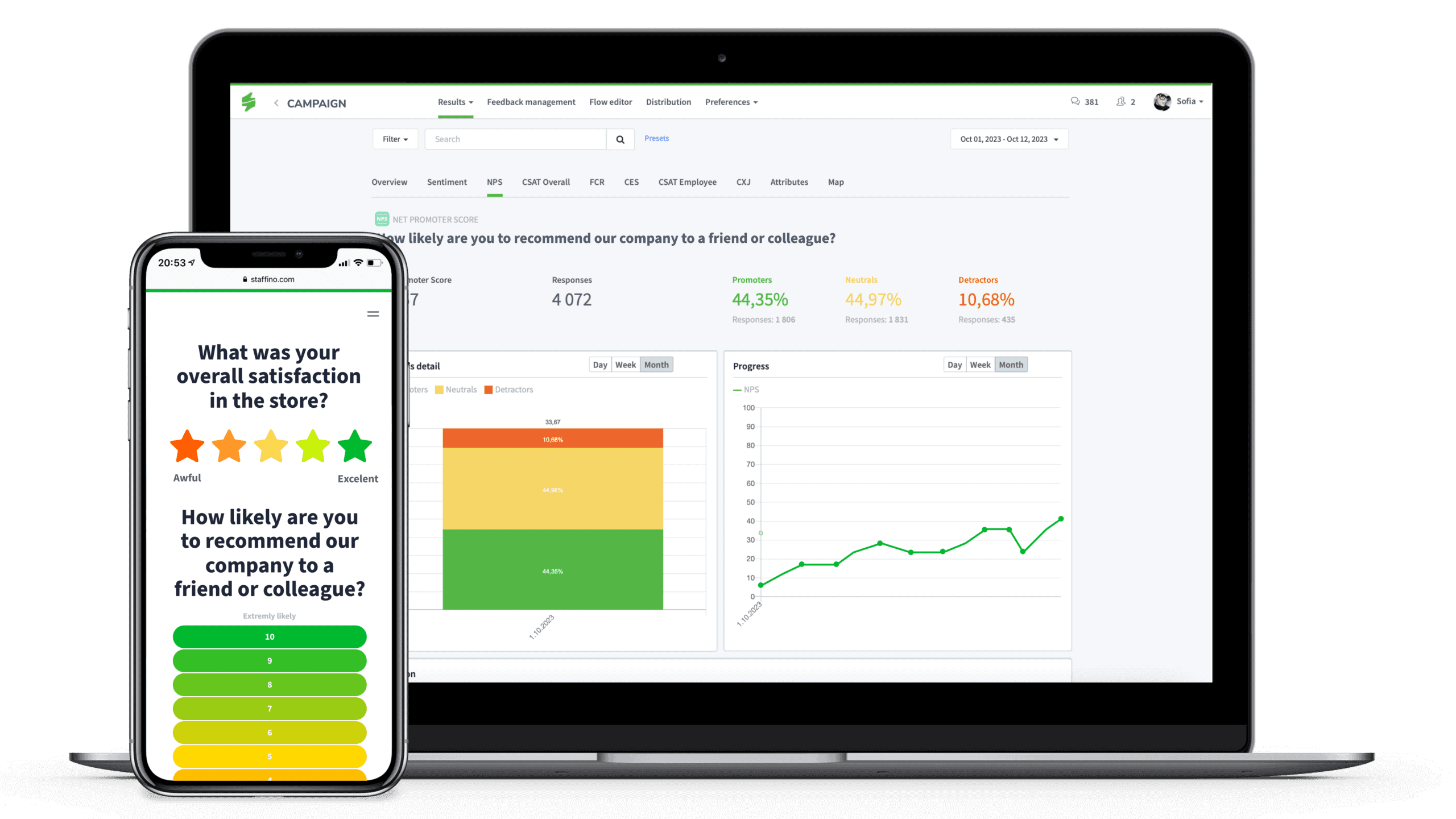
The typical format is:
- You ask a net promoter question (the core NPS question).
- You optionally follow it with an open-ended feedback question or comment box.
- You segment respondents into promoters, passives, and detractors.
- You compute the score as the percentage of promoters minus the percentage of detractors (on a –100 to +100 scale).
Because NPS is simple, it offers a clear benchmark and a strong signal to leadership. Many CX management platforms, including Staffino, integrate NPS as one of the core customer experience metrics in their feedback and analytics suite.
How to Create a Net Promoter Score Survey
When using NPS, you’ll want to balance simplicity, clarity, and context. Below is a practical step-by-step:
1. Define Your Objective and Scope
Decide whether this is a transactional NPS (tNPS) tied to a specific event, e.g. post‑support, after purchase, or a relational NPS (rNPS) to capture overall customer sentiment over time. Each has value.
2. Craft Your How Likely Are You to Recommend Survey Question
If you’re looking for Net Promoter Score question examples, you’ve come to the right place. A classic version is:

That formulation, often called the net promoter question, is standard and easy for your audience to understand.
However, there are other, less frequently used formulations:
“How likely are you to recommend [Company/Product] to others?”
“How likely are you to suggest [Product/Service] to someone like you?”
“On a scale from 0 to 10, how willing are you to refer us to a friend or colleague?”
“How likely are you to tell a friend about your experience with us?”
“How likely are you to advocate for [Brand]?”
“Would you recommend [Company/Product] to your peers or colleagues?”
3. Add a Follow-up Question or Comment Box
Right after the rating, ask an open-ended question for feedback on the chosen score, such as:
“What is the primary reason for your score?”
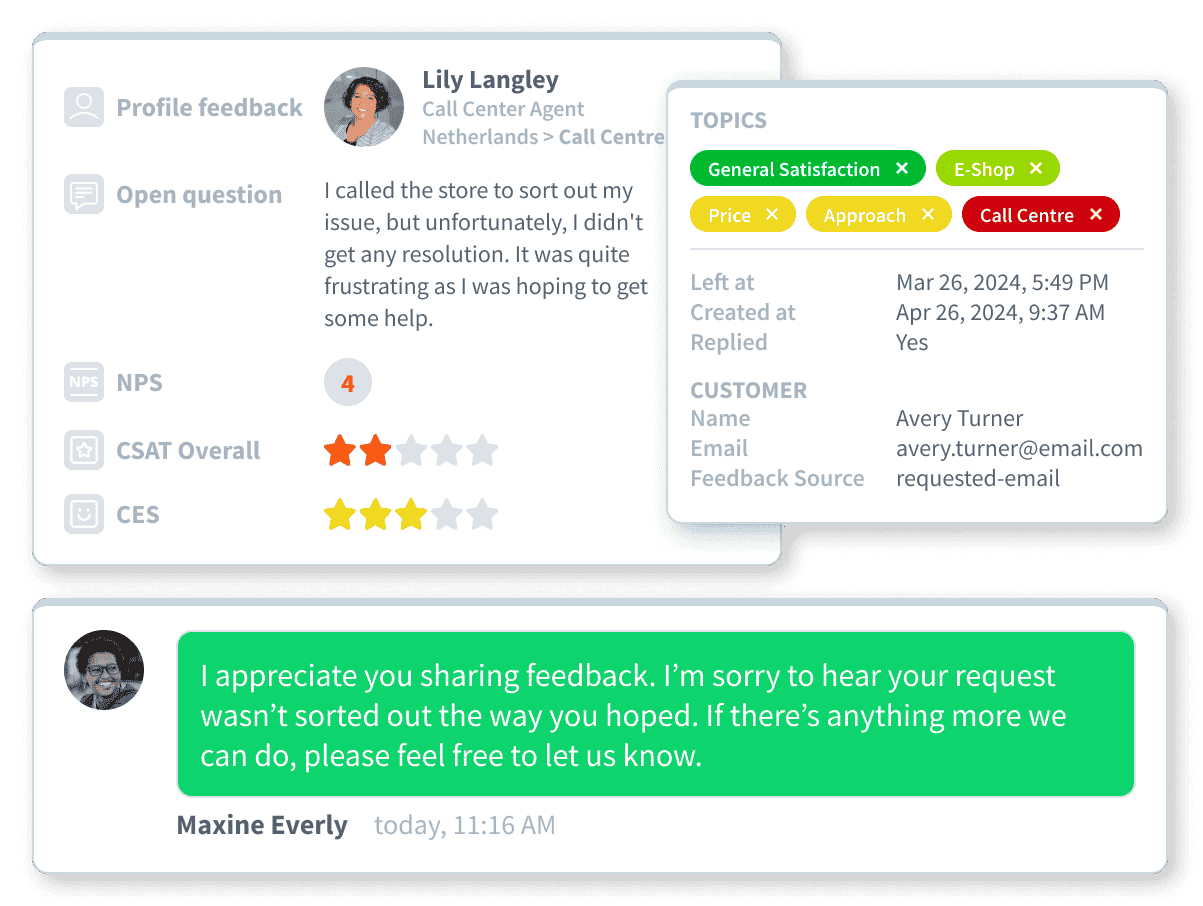
This NPS follow up question gives you qualitative insight, i.e. what motivates praise or frustration. You can also tailor follow-up questions depending on whether the respondent is a promoter, passive, or detractor.
4. Limit Survey Length and Friction
One or two questions are often optimal. The easier it is to respond, the better your response rate will be.
5. Use a Reliable Tool or Platform
You’ll want automation, analytics, segmentation, and integration with your CRM or support tools. A CX platform like Staffino supports NPS, CSAT, CES and other metrics under one roof, making survey management scalable and letting you track trends and action plans.
6. Pilot, Test, and Refine
Test your customer survey on a small segment first, monitor open and completion rates, check for ambiguous interpretations, and iterate.

Transform Your Customers' Experiences
Create a bulletproof customer journey with tailored CX products and services that will foster loyalty and reduce churn.
When to Send NPS Survey?
The timing of your NPS e‑mail can make or break response rates and accuracy of feedback. Below are timing best practices and common pitfalls:
Best Practices for Transactional NPS Surveys
- Send your CX survey shortly after the event or interaction, when the experience is fresh. For example:
- 0–24 hours after a support ticket closes
- 1–2 days after product delivery or service completion
- After a major milestone or usage event (feature adoption, onboarding completion, etc.)
Avoid sending too early (customers haven’t used the product yet) or too late (they forget details).
Cadence for Relational Surveys
- For rNPS, send at predefined intervals (e.g. quarterly or biannually).
- Align relational survey timing to strategic periods: before contract renewals, ahead of executive reviews, or after peak usage.
- Avoid survey fatigue: limit contact frequency (e.g. one survey per quarter per customer) and ensure internal coordination so multiple teams don’t over-survey the same contact.
Best Days & Times of Day
- Mid‑week (Tuesday–Thursday) tends to be better than Mondays or Fridays.
- Late morning (9 a.m.–11 a.m.) in the customer’s local time zone is often optimal.
- Avoid end-of-day or weekends when email engagement is lower.

By carefully choosing when to send NPS survey, you boost response rates, avoid fatigue, and get more reliable, timely feedback.
NPS Email Templates
Here are several ready-to-use NPS survey examples or templates for different occasions. You can adapt them to your brand voice or use them with tools like Staffino to send and track performance.
Template A: Transactional NPS Survey (Post-Support Interaction)
SUBJECT: Quick Feedback: How Did We Do Today?
Hi [Customer Name],
Thank you for letting us assist you with [issue or ticket reference]. We value your opinion and would love to hear how satisfied you are with our support.
On a scale of 0 to 10, how likely are you to recommend our support to a colleague or friend?
[0 – 1 – 2 – … – 10]
What is the primary reason for your score?
[Open text box]
Your feedback helps us improve and ensures we deliver better service going forward.
Best regards,
[Your Name / Team]
[Company]
Template B: Relational NPS Survey (Periodic Pulse Check)
SUBJECT: We’d Love Your Feedback | ≤1 Minute
Hi [Customer Name],
As part of our ongoing efforts to serve you better, we seek your feedback on your overall experience with us in the past months.
On a scale from 0 to 10, how likely are you to recommend our company to a friend or colleague?
[0 – 1 – 2 – … – 10]
What made you choose that score?
[Open text box]
We deeply appreciate your time. Your insights guide our roadmap and improvements.
Warm regards,
[Your Name / CX Team]
[Company]
Template C: Follow-up request (if no response)
SUBJECT: Quick Reminder! Your Feedback Matters…
Hi [Customer Name],
A few days ago, we sent you a feedback request and noticed you haven’t had a chance to respond. If you have one minute, we’d love your thoughts.
On a scale from 0 to 10, how likely are you to recommend us?
[0–10]
Just one more question: what’s your reason?
[Open text box]
Thank you for helping us serve you better.
Best,
[Your Name / Team]
[Company]
Template D: Reaction-based follow-up (after a positive rating)
SUBJECT: Thank You for Your Feedback!
Hi [Customer Name],
Thanks for your rating of [score]. We’re thrilled you’re satisfied! Could you spare another minute to tell us why you scored us that way?
[Open text box]
If there’s anything more we can do to make your experience exceptional, just let us know.
Kind regards,
[Your Name / Team]
[Company]
You can adapt these templates to your automation workflows. A customer experience platform often allows you to set conditional follow-ups (e.g. one template for detractors, another for promoters), schedule reminders, and surface analytics and trends transparently.
NPS Survey Best Practices & Tips for Getting Better Insights
Here are additional recommendations to improve your net promoter score email:
- Personalise the email: use the customer’s name, context (e.g., “your recent support case”), and segment-based branding.
- Set expectations on time commitment: e.g. “This survey takes <1 minute” makes people more willing.
- Send a reminder: one follow-up 48–72 hours later often boosts responses without being intrusive.
- Avoid over-surveying: especially in B2B, limit NPS asks to once per quarter unless there’s a strong business reason.
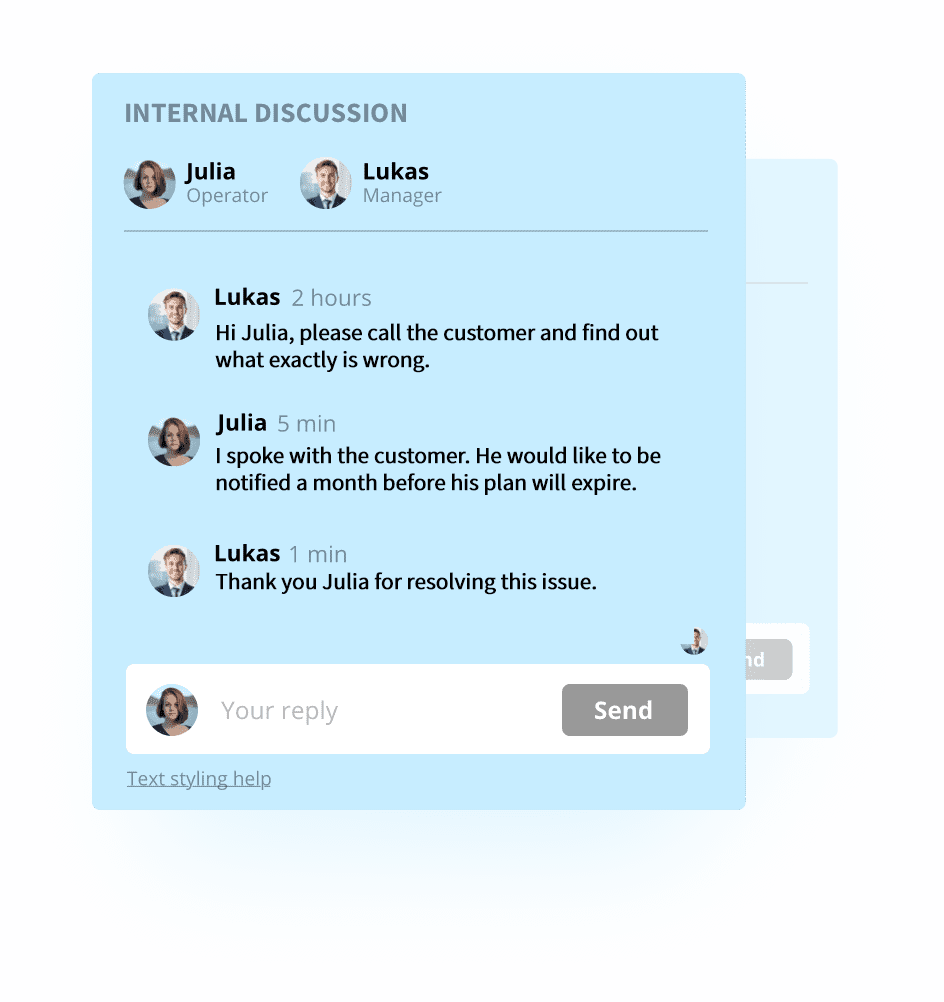
- Track and act on feedback: close the loop with detractors, thank promoters, and use qualitative feedback to plan improvements.
- Segment and benchmark: compare NPS by customer segment, product line, or geography. Use trend analysis rather than single-point scores.
- Use analytics & CX dashboards: to spot patterns, response trends, and link NPS to reasons for customer churn, growth, or retention metrics. Tools like Staffino let you integrate feedback and operations data in one place.

- Test subject lines, send times, and templates: A/B test to optimise your open and completion rates.
- Avoid mandatory pop-ups: forced surveys can generate biased or negative responses. Let people skip if they prefer.
Conclusion
NPS email templates are more than just a feedback prompt. They’re a critical link between customer feelings and actionable business insight. By understanding what a good NPS score email looks like, constructing clear NPS survey questions, choosing the best time to send nps survey, and deploying well‑crafted NPS email templates, you can design a high-performing feedback program.
If you want a turnkey solution, Staffino can simplify your customer satisfaction survey setup, automation, analytics, and closing the feedback loop, helping you scale your CX efforts with confidence.
Get a First-Hand Experience Today!
Staffino is the perfect tool for creating engaging surveys, tracking performance, responding to customer feedback, and rewarding top employees. Get started today with our FREE demo!
FAQ
The “How likely are you to recommend” question is the foundation of every Net Promoter Score (NPS) survey. It asks respondents to rate, on a scale from 0 to 10, how likely they are to recommend a company, product, or service to a friend or colleague. This simple question helps measure customer loyalty and is used to categorise respondents as promoters, passives, or detractors based on their score.
In customer experience surveys, NPS stands for Net Promoter Score. It’s a widely used CX metric that helps businesses understand how loyal and satisfied their customers are. The score is calculated by subtracting the percentage of detractors (those who rate 0–6) from the percentage of promoters (those who rate 9–10), resulting in a score between –100 and +100.
To calculate your Net Promoter Score, you first ask customers the standard question about their likelihood to recommend your company. Then, based on their responses, classify them into promoters, passives, or detractors. The NPS is calculated by subtracting the percentage of detractors from the percentage of promoters. This gives you a clear, numerical indicator of overall customer sentiment and loyalty.
Creating a Net Promoter Score survey involves asking the key question about recommendation likelihood, followed by an optional open-ended question that invites the respondent to explain their score. Keeping the survey short, ideally just one or two questions, ensures higher response rates. For best results, use a customer experience platform that automates the process and helps track insights over time.
The ideal timing for sending an NPS survey depends on its purpose. For transactional NPS, it’s best to send the survey within 24 hours of a specific customer interaction, such as a support call or product delivery. For relational NPS, sending surveys at regular intervals, like quarterly or biannually, helps track overall sentiment. Mid-week mornings in the recipient’s local time zone tend to yield the highest response rates.