


A high-converting customer feedback survey is designed to maximise response rates while collecting actionable insights that organisations can use to improve customer experience. The key lies in combining clear objectives, thoughtful question design, the right survey type, and data-driven analysis. When done correctly, designing customer feedback surveys that drive insights helps organisations understand customer needs, reduce friction across the customer journey, and make better strategic decisions.
In today’s experience-driven economy, companies cannot rely solely on intuition to understand their customers. Every interaction across the customer journey, from first contact to post-purchase support, creates valuable feedback signals. Capturing these signals systematically through a customer feedback survey enables companies to translate customer experiences into measurable insights.
However, not all surveys are effective. Many companies struggle with low response rates, vague answers, and feedback that cannot be translated into actionable decisions. Poorly designed CX surveys often frustrate customers rather than empower organisations.
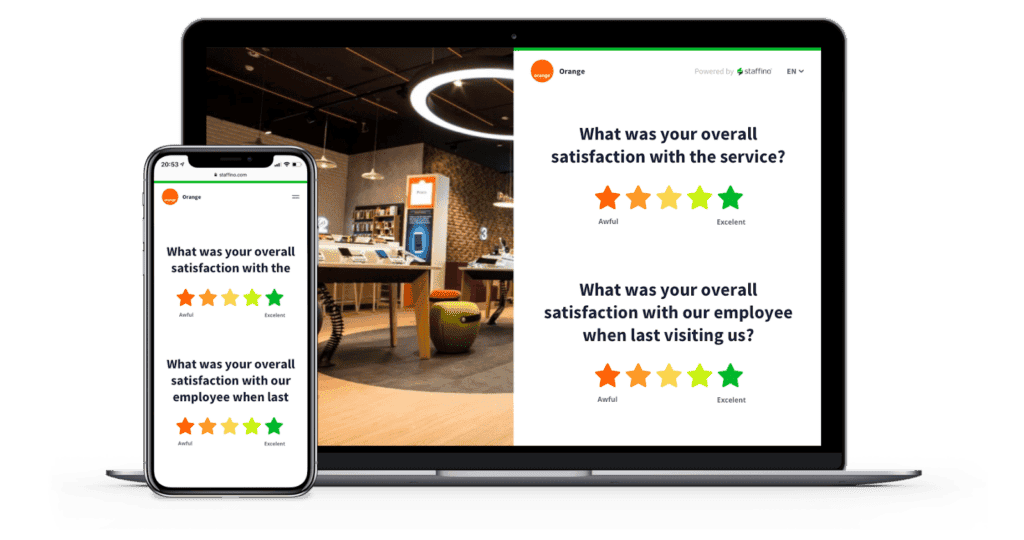
The difference between a low-performing questionnaire and a high-converting survey design lies in the strategic approach behind it. Successful surveys are short, relevant, and aligned with specific customer journey moments. They use well-structured questions, thoughtful timing, and advanced analytics to extract meaningful insights.
This article explores how to design surveys that customers are willing to complete and that leadership teams can actually use to improve products, services, and operations.

Launch Smarter CX with Staffino Core
Start collecting customer feedback, managing responses in real time, and visualising what drives satisfaction. Build experiences that make people come back. All in one core solution.
The Role of Customer Feedback in the Modern Customer Journey
Today, customer journeys are complex and multi-channel. Customers interact with brands through mobile apps, websites, stores, customer support, and social media. Each of these touchpoints shapes the overall perception of the brand.
Customer feedback surveys help organisations map these experiences by collecting structured feedback at critical moments.
When companies systematically gather feedback, they can:
- Identify friction points across the customer journey
- Measure customer satisfaction and loyalty
- Detect operational issues early
- Prioritise improvements based on real customer data
Companies that embed CX surveys into their customer journey strategy are significantly more likely to achieve sustainable growth.
Research consistently shows the business impact of listening to customers. According to multiple CX studies, companies that actively collect and analyse customer feedback outperform competitors in revenue growth and customer retention.
However, the value of feedback depends on the quality of the survey design.
Types of Customer Feedback Surveys (CSAT, CES, NPS & More)
Different customer experience metrics serve different purposes. Understanding when to use each type is essential when designing customer feedback surveys that drive insights.
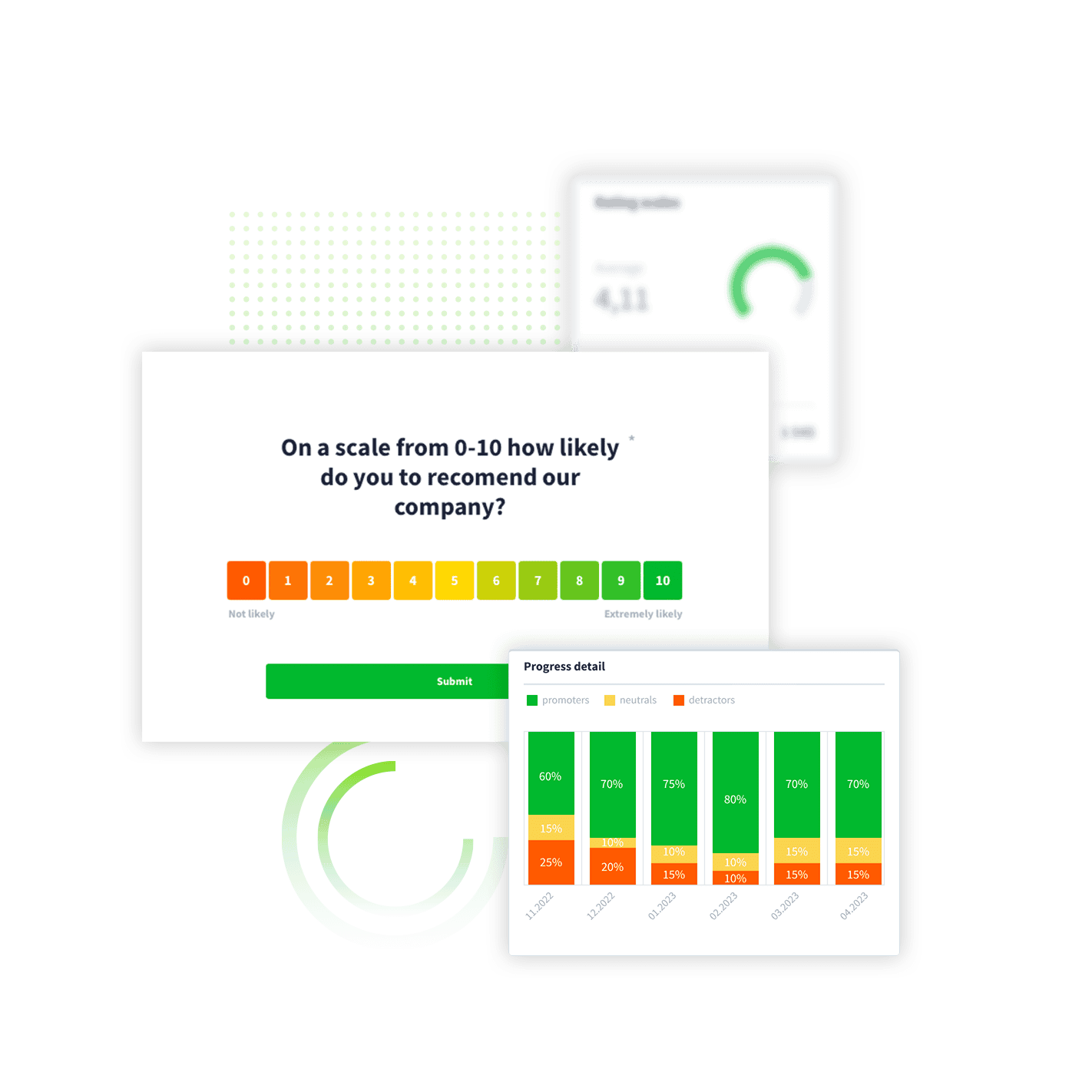
Below is a simple overview of the most common survey templates for CSAT, CES, NPS.
Survey Type | Purpose | Example Question | Best Use Case |
CSAT (Customer Satisfaction Score) | Measures satisfaction with a specific interaction | “How satisfied were you with your recent purchase?” | Post-purchase, support interactions |
CES (Customer Effort Score) | Measures how easy it was for the customer to complete a task | “How easy was it to resolve your issue today?” | Customer support, onboarding |
NPS (Net Promoter Score) | Measures loyalty and likelihood to recommend | “How likely are you to recommend our company to a friend or colleague?” | Relationship surveys |
Open-ended feedback | Provides qualitative insights | “What could we improve?” | Deeper experience insights |
Combining these approaches creates a more complete picture of the customer journey. For example, an NPS survey may highlight declining loyalty, while a CES survey can reveal the operational friction causing it.
Companies often rely on customer survey templates to standardise data collection across departments and markets.
How to Create Effective Customer Surveys
Designing a survey that customers actually complete requires careful planning. The most successful high-converting survey design processes typically follow several steps.
1. Define a Clear Objective
Before writing questions, you should ask:
- What decision will this survey inform?
- Which part of the customer journey are we measuring?
- Who will use the insights?
Without a clear objective, surveys become long, unfocused, and difficult to analyse.
For example:
- A retail brand may want to measure checkout satisfaction.
- A SaaS company may want feedback on the onboarding experience.
- A support team may focus on resolution efficiency.
Each goal requires a different customer feedback survey structure.
2. Keep Surveys Short and Focused
One of the most important tips to increase survey completion rates is simplicity.
Customers rarely want to spend more than a few minutes answering questions. Research shows that shorter questionnaires dramatically increase survey response rates.
Best practices include:
- 3–5 core questions
- One optional open-ended feedback question
- Clear and simple language
- Mobile-friendly design
The goal is not to ask everything. It’s to ask the right questions.
3. Choose the Right Question Types
Survey psychology plays a significant role in response quality.

Effective CX surveys usually combine:
- Rating scales (1–5 or 0–10)
- Multiple-choice questions
- Open-ended responses
This combination allows you to collect both quantitative metrics and qualitative context.
For instance:
- Rating scales help track trends over time.
- Multiple-choice questions identify common issues.
- Open-ended responses uncover unexpected insights.
4. Use Smart Survey Timing
Timing is one of the most overlooked aspects of designing customer feedback surveys that drive insights. Feedback is most accurate when collected immediately after a relevant experience.
Examples include:
- After a purchase
- After interacting with customer support
- After product onboarding
- After using a service
Journey-based feedback collection helps companies capture authentic customer sentiment.
Example Customer Feedback Questions by Industry
Different industries require different survey approaches. Below are several example customer feedback questions by industry.
Retail
- How satisfied were you with your in-store experience?
- Did our staff help you find what you needed?
- What could we improve during your next visit?
Banking and Financial Services
- How easy was it to complete your transaction today?
- Did our digital banking platform meet your expectations?
- What could we improve in your banking experience?
Telecommunications
- How satisfied are you with your network reliability?
- Was your issue resolved during your support interaction?
- What improvements would make your service better?
SaaS and Technology
- How easy was it to get started with our product?
- Which feature provides the most value to you?
- What challenges did you encounter during onboarding?
Using tailored survey templates for different industries ensures that feedback is both relevant and actionable.

Ready-Made XM Solutions for Your Industry
Looking for Experience Management solutions for a particular industry or team within your company? Staffino's got you covered! Check out our comprehensive XM solutions and find the right fit for your business.
Tips to Increase Survey Completion Rates
Even the best survey questions cannot deliver insights if customers do not respond. Improving participation requires thoughtful design and communication. Some proven tips to increase survey completion rates include:
1. Make Surveys Mobile-First
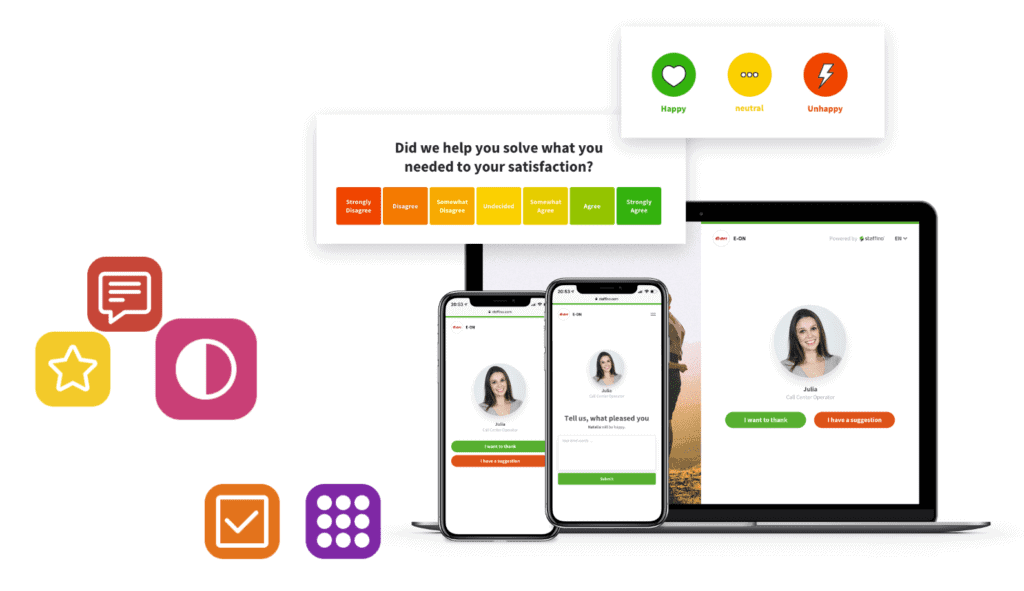
Most feedback is submitted on smartphones, so surveys must load quickly and display clearly on small screens.
2. Personalise Survey Invitations
Customers are more likely to respond when the survey feels relevant to their experience.
3. Send Surveys at the Right Time
Immediate feedback requests after interactions typically achieve the highest response rates.
4. Explain the purpose of the survey
Customers are more willing to participate if they know their feedback will lead to improvements.
5. Show that Feedback Matters
Organisations that visibly act on feedback often see higher engagement in future surveys.
How AI and Analytics Improve Survey Insights
Collecting feedback is only the first step. The real value lies in turning survey responses into actionable insights. Today’s experience management platforms increasingly rely on AI customer experience analytics to analyse feedback at scale.
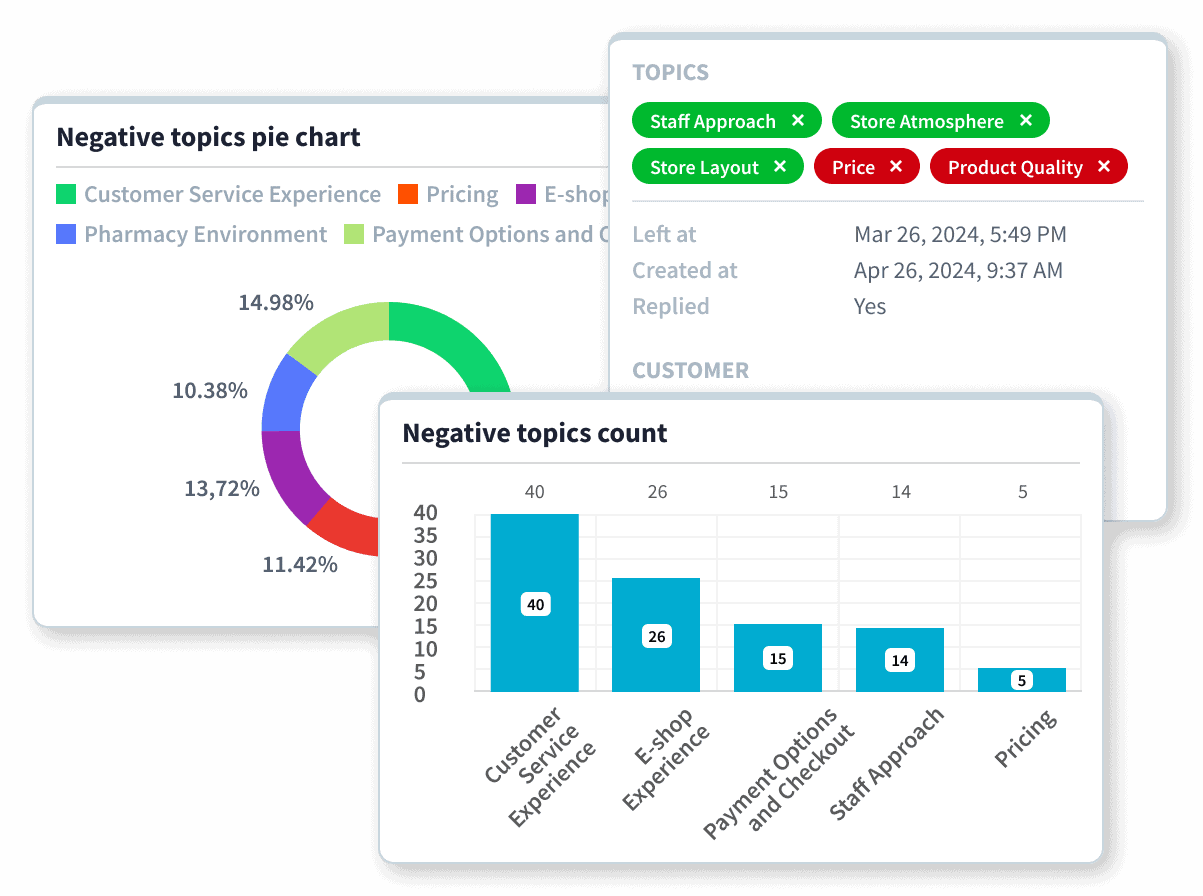
AI can:
- Detect customer sentiment in open-ended responses
- Identify recurring issues across locations or teams
- Predict churn risk based on feedback patterns
- Automatically categorise qualitative feedback
These capabilities transform traditional customer feedback surveys from simple reporting tools into strategic decision-making assets. Advanced CX platforms also integrate feedback with operational data such as transactions, support tickets, and product usage.
This allows leaders to connect customer sentiment with business outcomes.
Let AI Handle the Heavy Lifting in CX
With Staffino’s AI, you can respond with empathy at scale, understand customer feedback faster, boost upsell, and make smarter decisions with almost no effort.
Turning Survey Data Into Strategic Decisions
Companies often collect large volumes of survey data but struggle to translate it into meaningful improvements. The most successful CX programs close the feedback loop.
This means:
- Analysing feedback trends
- Sharing insights with relevant teams
- Implementing operational changes
- Measuring the impact
- Informing customers
For example, if a CES survey shows high effort in customer support interactions, leadership may invest in better self-service tools or training. Similarly, recurring complaints about the checkout experience in retail may lead to process redesign.
The key is ensuring feedback leads to action.
How Technology Helps Create High-Converting Surveys
Designing effective surveys manually can be time-consuming and difficult to scale across large organisations. Customer experience platforms help automate and optimise the process.
Solutions such as Staffino help companies:
- Create optimised survey templates for CSAT, CES, and NPS
- Collect feedback across multiple touchpoints
- Analyse data using AI-powered insights
- Identify improvement opportunities in real time
In addition to the technology itself, CX consultants can help you design high-converting survey design strategies tailored to their industry and customer journey. This combination of platform and expertise allows companies to move beyond simple feedback collection toward true experience management.
Conclusion
A well-designed customer feedback survey is one of the most powerful tools for understanding customer experiences and improving business performance. However, effective surveys require more than simply asking questions. They must be strategically designed, aligned with the customer journey, and supported by strong analytics.
If your organisation wants to create high-converting CX surveys that generate actionable insights, the right technology and expertise make all the difference.
Staffino can help you design and deploy effective customer feedback surveys, analyse feedback with AI-powered insights, and turn customer voices into measurable improvements. Try our free demo today!

Get a First-Hand Experience Today!
Staffino is the perfect tool for creating engaging surveys, tracking performance, responding to customer feedback, and rewarding top employees. Get started today with our FREE demo!
FAQ
A customer feedback survey is a structured set of questions used to collect customer opinions about products, services, or experiences. These surveys help organisations understand customer satisfaction, loyalty, and areas for improvement.
A high-converting survey design is short, relevant, and easy to complete. It focuses on clear objectives, uses simple questions, and is delivered at the right moment in the customer journey.
The most widely used CX surveys include CSAT (Customer Satisfaction Score), CES (Customer Effort Score), and NPS (Net Promoter Score). These surveys measure satisfaction, effort, and loyalty across different touchpoints.
Most effective surveys include 3–5 questions and take less than two minutes to complete. Short surveys significantly increase response rates.
Survey templates help organisations standardise feedback collection across teams and locations. They ensure consistent measurement and make it easier to compare results over time.
To create effective customer feedback surveys, focus on clear goals, concise questions, and the right timing in the customer journey. Using proven survey templates for CSAT, CES, and NPS helps standardise feedback collection while keeping surveys short and easy to complete. The most effective CX surveys combine rating questions with one open-ended question to capture insights that support better decision-making.