

To combine CSAT (Customer Satisfaction Score) and CES (Customer Effort Score), include both CX metrics in the same post-interaction survey. This allows you to measure customer satisfaction and the ease of experience simultaneously. Analysing these scores together provides deeper insights into service quality, customer effort, and employee performance, helping optimise touchpoints across the entire customer journey.
Customer feedback is critical to shaping a better customer experience. But with so many metrics available, like CSAT, CES, NPS, and others, it can be overwhelming to decide what to measure and when. Two of the most insightful metrics for understanding specific interactions are CSAT (Customer Satisfaction Score) and CES (Customer Effort Score). While they serve different purposes, combining CSAT and CES can give you a more nuanced, actionable understanding of your customer journey.
In this article, we’ll explore how to combine CSAT and CES, when to use each, and why using both can help businesses make smarter CX decisions. We’ll also touch on how customer experience platforms help companies track and act on these metrics effectively.

Boost Customer Experience with NPS, CSAT & CES
Get the most accurate and actionable insights into your customer satisfaction with Staffino's CX metrics. With automated surveys and effective reporting, you can quickly gain valuable insights into your customer journey.
What Are CSAT and CES?
Before diving into how to use them together, let’s briefly define each metric.
CSAT (Customer Satisfaction Score) measures how satisfied a customer is with a specific interaction, product, or service. It typically asks:

Answers usually range on a 1–5 or 1–10 scale, or with emoji/face icons.
CES (Customer Effort Score) measures the ease or difficulty a customer experienced in completing a specific task, such as resolving an issue or finding information. The common question is:

Ratings are usually on a 1–7 scale, where lower effort (e.g., a 1 or 2) is better.
These are transactional metrics—focused on evaluating specific touchpoints in the customer journey—and they serve different but complementary purposes.
How to Combine CSAT and CES?
Combining CSAT and CES involves measuring both customer experience metrics for the same touchpoint or service interaction to gain a more well-rounded understanding of what the customer experienced and how they felt about it.
Here’s a step-by-step approach:
1. Include both questions in the same post-interaction survey
For example, after a customer support interaction, you can ask:
- How satisfied were you with the support you received? (CSAT)
- How easy was it to get your issue resolved today? (CES)

2. Analyse the responses together, not in isolation
A high CSAT and low CES suggest the customer was happy and had a seamless experience. A high CSAT and high CES (meaning more effort) might mean the agent was good, but the process was frustrating.
3. Use feedback segmentation
Segment your feedback based on both metrics to identify specific patterns, such as areas where satisfaction is high, but effort is still too high. This is where AI feedback analytics tools can offer real value through automated topic and sentiment detection.
When to Use CSAT vs CES
Each metric shines in different scenarios. Knowing when to use CSAT vs CES can help you avoid customer survey fatigue and collect more relevant data.
Scenario | Use CSAT | Use CES |
After a product purchase | ✅ | ❌ |
After resolving a support ticket | ✅ | ✅ |
After onboarding completion | ✅ | ✅ |
Navigating the self-service portal | ❌ | ✅ |
Submitting a refund or return request | ✅ | ✅ |
If you’re trying to assess how customers feel, use CSAT. If you want to measure how easy or difficult an experience was, use CES.
CSAT vs CES: Which Is Better?
CES vs CSAT, which is better? The answer depends on your goals.
- CSAT helps you measure overall satisfaction, which is ideal for understanding emotional responses and surface-level sentiment.
- CES is more predictive of future behaviour, like loyalty or causes of customer churn. Research has shown that reducing customer effort is more strongly correlated with loyalty than delighting customers.
So, CSAT vs CES isn’t a competition; it’s a strategic pairing. Using them together offers a deeper lens into both emotion and friction.
How to Measure CSAT and CES Together
To measure CSAT and CES together, use a single transactional customer satisfaction survey that includes both questions, ideally right after a customer interaction. This way, the feedback is fresh and relevant.
Example survey:
Q1: How satisfied were you with your recent interaction with our support team?
Scale: 😡 😕 😐 🙂 😃 (or 1 to 5)
Q2: How easy was it to get your issue resolved today?
Scale: Very Easy (1) to Very Difficult (7)
Customer experience management platforms like Staffino simplify this by allowing you to build surveys with multiple question types, track both metrics over time, and analyse open-ended responses in the same CX dashboard.

Get a First-Hand Experience Today!
Staffino is the perfect tool for creating engaging surveys, tracking performance, responding to customer feedback, and rewarding top employees. Get started today with our FREE demo!
Best Way to Use CSAT and CES
The best way to use CSAT and CES is to treat them as complementary data points:
- CSAT tells you what the customer felt.
- CES explains why they felt that way.
For instance, if CSAT is high but CES is poor, you might learn that customers like your service team but hate the complex procedures they must follow. This opens up opportunities to streamline processes or improve self-service tools.
Examples of CSAT and CES Surveys
Below are a few examples of CSAT and CES surveys used in different industries:
Customer Support

- CSAT: “How satisfied were you with the support you received today?”
- CES: “How easy was it to get your issue resolved?”
E-commerce
- CSAT: “How satisfied were you with your shopping experience?”
- CES: “How easy was it to find what you were looking for?”
Banking
- CSAT: “How would you rate your experience applying for a loan?”
- CES: “How easy was the loan application process?”
Travel & Hospitality
- CSAT: “How satisfied were you with your check-in experience?”
- CES: “How easy was it to complete the check-in process?”
We recommend you pair these with open-ended feedback questions and analyse collected data at scale using AI-powered sentiment and topic analysis.
CSAT vs CES Pros and Cons
Let’s take a look at the pros and cons of using CSAT and CES:
CSAT Pros
- Simple and familiar to customers
- Measures satisfaction with specific moments
- Easy to benchmark over time
CSAT Cons
- Can be emotionally biased
- Doesn’t reveal root cause or effort required
CES Pros
- Strong predictor of loyalty
- Helps identify process friction points
- Focused on functional improvements
CES Cons
- Less emotional context
- May confuse respondents unfamiliar with the scale
Combining both provides a balanced view of satisfaction and ease, making your CX feedback more actionable.
CSAT and CES in the Customer Journey
Throughout the customer journey, CSAT and CES can be strategically placed at key touchpoints to monitor experience quality and effort:
Stage | Metric to Use | Purpose |
Onboarding | CES + CSAT | Assess ease of getting started and overall satisfaction |
Purchase | CSAT | Gauge immediate satisfaction with the transaction |
Support | CSAT + CES | Evaluate the satisfaction and effort of problem resolution |
Post-service | CES | Measure how easy it was to complete a process (e.g. return) |
Using both metrics across the journey helps create a consistent, low-friction, high-satisfaction experience—the ultimate goal of modern CX strategies.
What About CSAT vs NPS vs CES?
If you thought two metrics were confusing enough, wait until we throw NPS into the mix. Here’s how they differ:
- CSAT = satisfaction with a specific interaction
- CES = effort required for a specific task
- NPS (Net Promoter Score) = overall brand loyalty and advocacy

NPS is best for long-term relationship health, while CSAT and CES are ideal for transactional feedback. All three together give you a powerful CX metrics framework, and Staffino supports tracking and analysing all of them in one platform.
CSAT and CES as Tools for Measuring Employee Performance
While CSAT and CES are primarily used to understand the customer experience, they also provide direct, measurable insights into frontline employee performance.
When mapped to individual agents or teams, these metrics can help identify who consistently delivers high-quality service and who may require additional support or training. For instance, a CSAT score above 90% is often correlated with strong communication, empathy, and issue-resolution skills. On the other hand, a CES score above 4.5 on a 7-point scale could indicate that customers are facing unnecessary friction, even if they are satisfied overall.
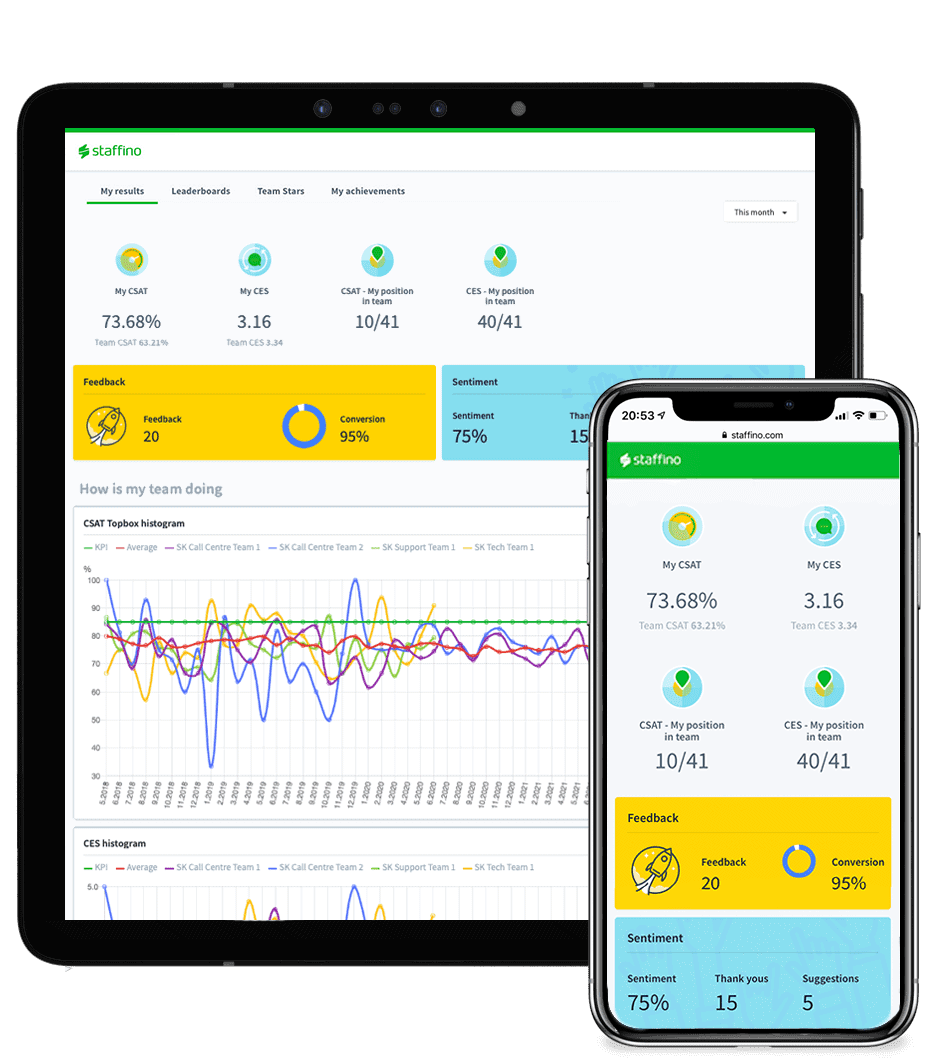
Platforms like Staffino take this further by linking CSAT and CES scores to individual employee performance management dashboards. This allows team leaders to:
- Measure performance and identify top-performing employees based on real-time customer feedback
- Detect early signs of burnout or disengagement through declining satisfaction trends
- Trigger instant recognition for employees who consistently exceed experience benchmarks
- Provide targeted coaching using real customer comments and sentiment analysis
Ultimately, CSAT and CES aren’t just customer metrics. They’re also a window into service quality, employee behaviour, and operational excellence.
Why Use Staffino for CSAT and CES Analysis?
Staffino is a leading customer experience platform that makes it easy to collect, analyse, and act on CSAT and CES data. Here’s how it helps:
- Create multi-question transactional surveys
- Analyse open-ended responses with AI-driven topic and sentiment detection
- Get real-time alerts for negative feedback
- Recognise employees automatically when CSAT or CES thresholds are exceeded
- Visualise data across the entire customer journey
If you want to master CSAT vs CES vs NPS and turn feedback into action, Staffino is a smart, scalable solution.
Improve Your CX Metrics with Staffino!
In the debate of CES vs CSAT, the answer isn’t to choose one over the other—it’s to use them together for greater clarity. Combining Customer Satisfaction Score and Customer Effort Score enables companies to understand both emotional satisfaction and process efficiency.
When measured at the right moments, both customer experience metrics guide strategic improvements in service, product design, and support. CX platforms like Staffino allow businesses to unify these metrics with open-ended feedback, employee performance data, and journey insights—helping create a seamless, loyalty-driving customer experience.

Give Your Employees the Recognition and Motivation They Deserve
Does your team need a little extra motivation? Our platform provides powerful insights into your team’s performance and various recognition tools that help ensure everyone feels appreciated.
FAQ
CSAT stands for Customer Satisfaction Score. It measures how satisfied customers are with a specific interaction, product, or service—typically through a quick rating scale (e.g., 1–5).
CES stands for Customer Effort Score. It measures how easy or difficult it was for a customer to complete a specific task, like resolving an issue or making a purchase.
You can combine CSAT and CES by including both questions in the same post-interaction survey. This helps capture both emotional satisfaction and ease of experience for a more complete view.
Use CSAT when you want to know how satisfied a customer is. Use CES when you want to measure how easy or difficult the interaction was. Often, they work best when used together.
Neither is universally better—they serve different purposes. CSAT captures satisfaction, while CES highlights friction. Together, they provide balanced insights into customer experience.
Use a single transactional survey with two questions—one asking about satisfaction (CSAT) and one about ease of experience (CES). Tools like Staffino make this process seamless and insightful.
The best way is to use them together at key touchpoints in the customer journey. Analyse both scores to identify areas where satisfaction is high but effort is too high, or vice versa.
A sample CSAT and CES survey may look like this:
1. CSAT: How satisfied were you with our support today? (1–5 scale)
2. CES: How easy was it to resolve your issue? (1–7 scale)