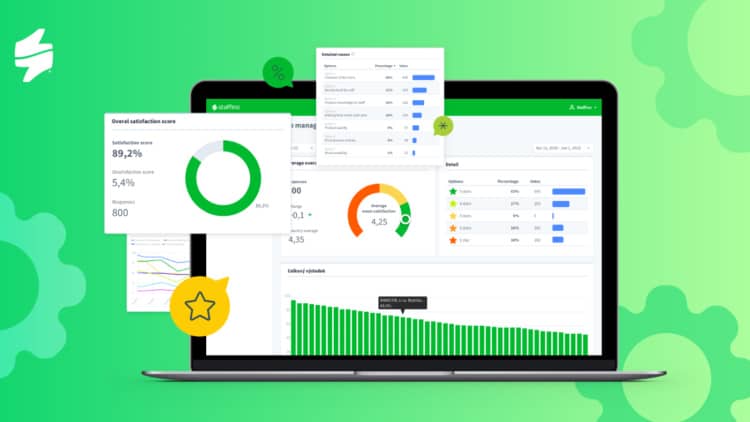


Customer experience KPIs for AI agents are measured by combining traditional CX metrics such as CSAT, NPS, CES, churn, and retention with AI-specific performance indicators like resolution rate, escalation frequency, intent accuracy, and conversation completion. To evaluate AI-driven interactions effectively, you must segment AI vs human interactions, collect real-time post-interaction feedback, analyse sentiment, and link customer satisfaction data directly to AI behaviours. This hybrid measurement approach ensures automation improves efficiency without compromising customer satisfaction or loyalty.
Artificial intelligence is rapidly reshaping customer experience. From chatbots and voice assistants to fully autonomous AI agents CX, organisations are automating large parts of customer interactions. While efficiency gains are often clear, a critical question remains: how do you measure customer experience KPIs when AI agents are involved?
Traditional CX metrics still matter, but AI changes how data is collected, interpreted, and acted upon. This article explores how to track, analyse, and interpret customer experience KPIs in AI-powered environments, combining classic CX frameworks with modern customer experience analytics.

Let AI Handle the Heavy Lifting in CX
With Staffino’s AI, you can respond with empathy at scale, understand customer feedback faster, boost upsell, and make smarter decisions with almost no effort.
Customer Experience KPIs and Their Role in AI Evaluation
Customer experience KPIs are measurable indicators used to evaluate how customers perceive interactions with a brand. These CX performance indicators guide strategic decisions, operational improvements, and technology investments.
When AI agents become part of the experience, KPIs serve an additional role:
- Evaluating AI agent effectiveness
- Detecting automation-driven friction
- Ensuring efficiency does not come at the cost of satisfaction
Without proper measurement, organisations risk optimising AI for speed and cost, while silently damaging trust and loyalty.
Key Customer Experience KPIs in AI-Powered Journeys
Despite new technologies, the foundation of CX measurement remains consistent. The most relevant CX metrics still apply, but require careful interpretation when AI agents are involved.
Core Customer Experience KPIs
KPI | What It Measures | Relevance for AI Agents |
CSAT | Immediate satisfaction | Quality of AI responses and resolution |
Loyalty and advocacy | Long-term impact of automation | |
CES | Effort required | Friction introduced or removed by AI |
Customer loss | Failures in AI-driven journeys | |
Retention Rate | Customer longevity | Success of AI-enabled experiences |
Together, these customer experience KPIs form the baseline for evaluating AI-supported interactions.
Measuring Customer Satisfaction Using Autonomous AI Agents
When customers interact with autonomous AI agents, satisfaction is influenced by different factors than in human-led interactions. Speed alone is not enough—clarity, empathy, simulation, and resolution quality matter just as much.
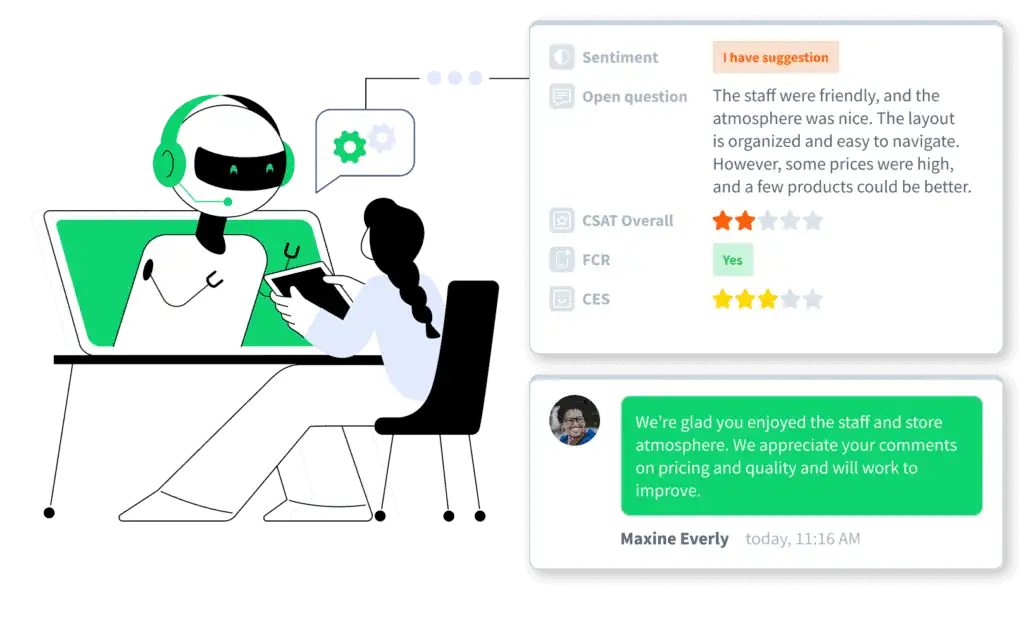
To measure customer satisfaction with AI, organisations should:
- Trigger CSAT surveys immediately after AI interactions
- Compare AI-led vs human-led satisfaction scores
- Analyse Net Sentiment Score from open-text feedback
- Track escalation rates to human agents
This approach ensures that the scores reflect experience quality, not just automation success.
How to Track KPIs for AI-Powered Customer Service Effectively
Tracking KPIs in AI-powered environments requires more granular data than traditional CX setups.

Best practices include:
- Tagging interactions handled by AI vs humans
- Tracking resolution confidence and fallback rates
- Monitoring AI handover effectiveness
- Linking CX metrics to specific AI behaviours
Key AI agent performance metrics include:
- First-contact resolution by AI
- Intent recognition accuracy
- Conversation completion rate
- Escalation frequency
- Reopen or repeat contact rate
When combined with classic CX metrics, these indicators reveal whether AI improves or degrades the overall experience.

Launch Smarter CX with Staffino Core
Start collecting customer feedback, managing responses in real time, and visualising what drives satisfaction. Build experiences that make people come back. All in one core solution.
How AI Agents Change Data Collection and CX Measurement
AI agents dramatically expand the volume and type of CX data available. Unlike traditional channels, AI interactions generate:
- Full conversation transcripts
- Behavioural signals in real time
- Structured and unstructured feedback
- Continuous interaction data across touchpoints
This enables advanced customer experience analytics, such as:
- Predictive churn modelling
- Automated pain-point detection
- Real-time customer sentiment tracking
- Root-cause analysis at scale
However, more data also means higher complexity. Without the right CX analytics platform, insights remain unused.
Best Practices for Combining Traditional CX KPIs with AI Insights
The most mature CX organisations do not replace traditional KPIs. They augment them with AI-driven insights.
Recommended Approach
- Keep CSAT, CES, NPS and NSS as core benchmarks
- Add AI-specific performance layers
- Analyse trends, not isolated scores
- Combine quantitative KPIs with qualitative insights
- Align CX metrics with business outcomes
This hybrid model ensures that the autonomous AI agents CX performance is evaluated holistically, not in isolation.
Reporting and Interpreting CX Data for Decision-Making
Practical Examples of CX KPI Reporting with AI
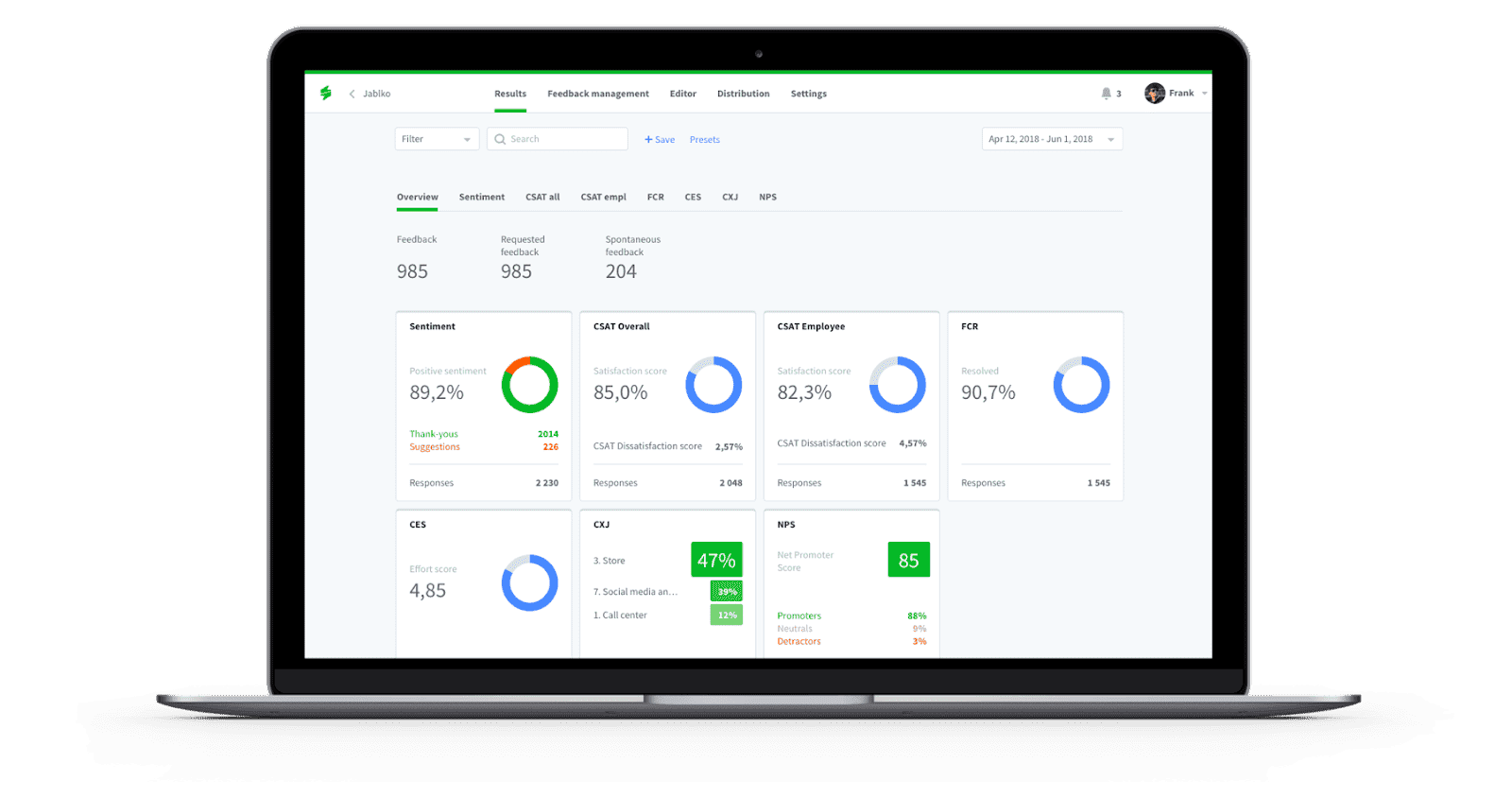
Effective reporting turns metrics into action. Companies with the best customer service do the following:
- Segment CX dashboards by channel and agent type (AI vs human)
- Visualise CX performance indicators over time
- Correlate CX metrics with customer churn, revenue, and retention
- Share insights across CX, product, and operations teams
For example:
- A drop in CSAT combined with low escalation rates may indicate unresolved AI issues.
- High CES scores alongside strong AI resolution rates signal successful automation.
This level of insight enables confident, data-driven decision-making.
Best Real-Time Feedback Tools for AI-Driven Customer Satisfaction Measurement
The following platforms go beyond basic customer satisfaction surveys, offering AI-powered insights, automated sentiment analysis, and real-time CX intelligence crucial for rapidly evolving digital experiences.
Here’s a snapshot of the best real-time feedback tools that excel in this space:
1. Staffino
TOP FEATURES: end-to-end AI-enhanced CSAT and CX actionability
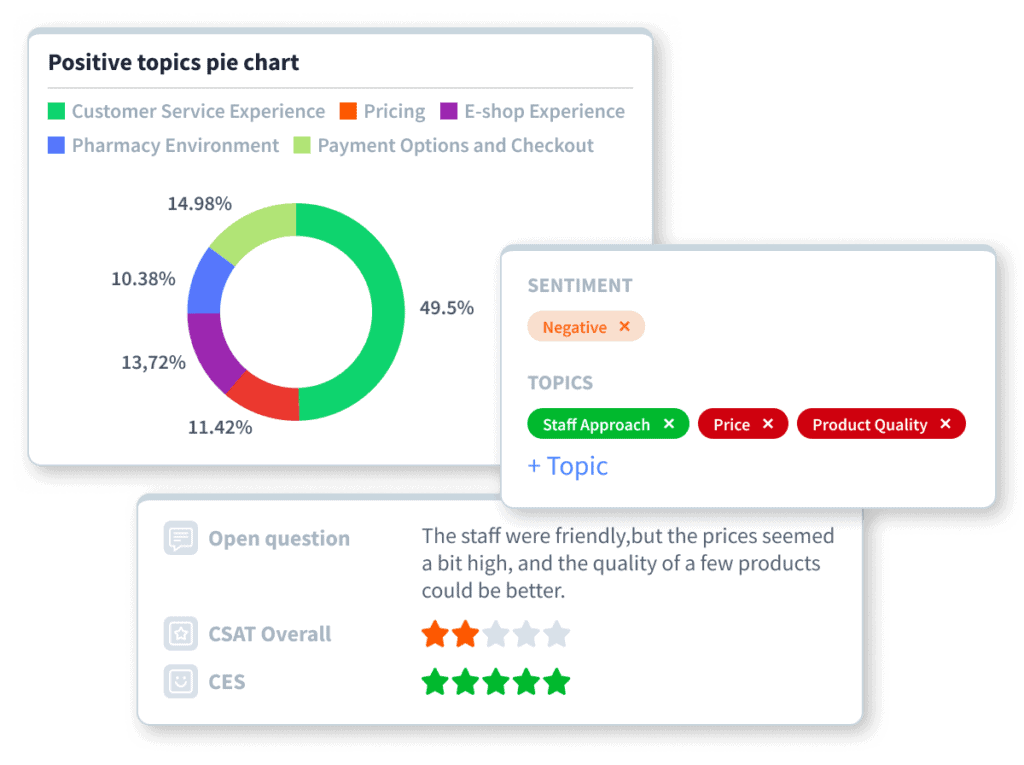
Staffino stands out by combining real-time feedback collection with advanced AI analytics that turn raw customer sentiment into actionable insights. With Staffino, businesses can measure key customer satisfaction metrics like NPS, CSAT, and CES instantly, and its AI tools help surface meaningful trends and themes across feedback channels, so teams can act fast and close the loop effectively. It also empowers frontline managers to respond directly and reward employees based on real customer sentiment.
2. Qualtrics
TOP FEATURES: enterprise-grade AI feedback and sentiment insights
Qualtrics is known for its powerful AI engines that support real-time analysis across surveys, digital touchpoints, and customer interactions. Its AI-driven text and voice analytics reveal sentiment shifts and satisfaction trends as data flows in, making it ideal for larger enterprises with complex feedback needs.
3. Enterpret
TOP FEATURES: AI-focused feedback intelligence
Enterpret uses adaptive AI models to unify feedback from multiple channels, including support tickets, social mentions, and reviews. Its automated theme extraction and sentiment detection help businesses understand not just what customers are saying, but why sentiment changes, enabling rapid satisfaction measurement and action prioritisation.
4. FeedbackRobot
TOP FEATURES: AI-driven real-time feedback summaries
FeedbackRobot blends real-time analytics with intelligent automation that summarises trends and emotions as they happen, reducing the lag between data collection and insights. This is especially useful for teams that want fast, AI-generated synthesis without heavy manual analysis.
5. Zigpoll
TOP FEATURES: AI-powered pulse surveys and segmentation
Zigpoll leverages AI to deliver adaptive pulse surveys and auto-segment respondents based on sentiment and behaviour, helping teams track satisfaction changes in real time and reveal customer segments that are improving or slipping in loyalty.
6. Surveybox.ai
TOP FEATURES: instant dashboards and AI summaries
This tool focuses on fast, real-time feedback deployment with AI-generated summaries and CRM integrations. Teams can launch surveys quickly and see satisfaction results immediately in intuitive dashboards, making it especially useful for e-commerce and mobile-first businesses.
What to Look for in an AI-Enabled Satisfaction Tool
When choosing tools to measure customer satisfaction with real-time AI support, consider these capabilities:
- Instant sentiment and theme detection: AI that automatically interprets open text and flags trends as they emerge.
- Multi-channel data integration: Support for surveys, chat, email, social, and app interactions.
- Actionable dashboards and alerts: Real-time intelligence that surfaces issues before satisfaction drops.
- Automated follow-ups or workflows: So teams can respond to dissatisfied customers immediately.
Each of these tools offers a different blend of speed, depth, and integration flexibility, but all leverage AI to make customer satisfaction measurement more immediate and insightful.
Conclusion: Measuring What Truly Matters in AI-Driven CX
AI agents are transforming customer experience, but success depends on measurement. Organisations that align customer experience KPIs, AI agent performance metrics, and advanced customer experience analytics gain a decisive advantage.
By combining traditional CX frameworks with AI-driven insights, businesses can ensure that automation enhances, rather than undermines, customer relationships.
Ready to measure and optimise AI-driven customer experience? Book a free demo with Staffino to see how real-time customer experience analytics help you track CX performance indicators, evaluate AI agent impact, and turn insights into measurable improvements.

Get a First-Hand Experience Today!
Staffino is the perfect tool for creating engaging surveys, tracking performance, responding to customer feedback, and rewarding top employees. Get started today with our FREE demo!
FAQ
Yes. Core CX metrics remain essential, but they must be enriched with AI-specific performance indicators.
By combining post-interaction surveys, sentiment analysis, and behavioural metrics such as escalation and repeat contact rates.
Resolution rate, escalation frequency, intent accuracy, and customer satisfaction scores tied specifically to AI interactions.
By connecting real-time feedback tools with AI performance data. Track traditional KPIs (CSAT, NPS, CES) alongside AI-specific metrics such as containment rate, escalation frequency, response accuracy, and resolution time. The key is monitoring these KPIs continuously and acting on them in real time, not just reporting on them later.
Customer satisfaction with autonomous AI agents is best measured immediately after each interaction using short, contextual surveys combined with AI-driven sentiment analysis. Real-time feedback platforms like Staffino help link satisfaction scores directly to AI interactions, making it easier to identify friction points, improve AI behaviour, and ensure the experience meets customer expectations.