


Employee engagement is often treated as an HR metric. But engagement becomes much more valuable when companies connect it to measurable outcomes such as employee performance, customer satisfaction, NPS, CSAT, and customer feedback. By combining employee surveys with operational and CX data, organisations can understand not only how engaged their people are, but also how engagement influences the way they perform.
This shift is changing the role of performance management and employee engagement. Instead of measuring engagement in isolation, companies can use employee and customer data together to identify what helps teams perform better, where support is needed, and which improvements can have the greatest business impact.
In this article, we explore the impact of employee engagement on performance, how employee feedback can be connected to CX metrics, and how managers can turn these insights into better coaching, recognition, and business outcomes.

Unlock Your Team's Full Potential with Staffino's EX Products
Our EX platform can help you attract and retain top talent, track employee performance, and improve engagement and productivity – so your team can reach their highest potential.
What Is the Link Between Employee Engagement and Performance?
Employee engagement and performance are closely connected, but they are not the same thing.
Engagement reflects how connected, motivated, supported, and committed employees feel towards their work and organisation. Employee performance focuses on how effectively they deliver against defined expectations and business objectives.
The relationship between the two becomes particularly important in customer-facing roles. An engaged frontline employee is more likely to feel motivated to provide good service, take ownership of customer problems, and contribute to a positive customer experience.
However, engagement alone does not guarantee high performance. Employees also need the right tools, training, clear expectations, effective management, and opportunities to develop. That is why effective employee engagement performance strategies should look at both sides of the equation.
From a “Soft” Metric to a Business Metric
For years, employee engagement was sometimes viewed as a qualitative HR indicator: useful for understanding morale, but difficult to connect directly to business results.
Today, organisations have access to far more data. Employee survey results can be combined with:
- Customer satisfaction scores
- NPS
- CSAT
- Customer feedback
- Productivity metrics
- Quality scores
- Absence and retention data
- Recognition activity
- Team and individual performance indicators
This creates an opportunity to move from asking “Are our employees engaged?” to asking “What does engagement enable our employees and teams to achieve?”
How Does Employee Engagement Affect Performance?
So, how does employee engagement affect performance in practice?

The relationship can appear in several ways.
Engaged employees are generally more likely to invest effort in their work, take ownership of problems, collaborate with colleagues, and remain committed when challenges arise. In customer-facing environments, these behaviours can directly influence the quality of service customers receive.
At the same time, low engagement can be an early warning signal. A team experiencing declining engagement may also show changes in customer satisfaction, service quality, productivity, or employee retention. These relationships will differ between organisations, which is why companies should analyse their own data rather than assume that engagement automatically causes a specific performance outcome.
The key is to look for meaningful patterns over time.
For example, a retailer could compare employee engagement scores across stores with customer satisfaction and customer feedback. If stores with stronger engagement consistently achieve better CX results, this creates a valuable starting point for further investigation.
Boost Employee Productivity through Gamification
Motivate and reward your employees with Staffino's Employee Gamification. Our platform provides custom challenges, rewards, and leaderboards to help you increase productivity and engagement.
Engagement Is An Input, Not the Entire Performance Equation
It is important not to oversimplify the relationship. Poor performance can have many causes: inadequate training, unclear processes, insufficient staffing, outdated technology, ineffective management, or unrealistic targets.
This is why performance management and employee development should complement engagement measurement.
Employee feedback can help identify why performance is changing, while operational and CX data can help show where the change is visible.
How Does Employee Engagement Affect Customer Experience?
For frontline teams, the connection between employee experience and customer experience is particularly visible.

Employees interact directly with customers, solve their problems, answer questions, and represent the brand. Their ability and willingness to do these things well can have a direct effect on the customer journey. Customer feedback can therefore become an important source of information about employee performance.
Consider a contact centre where customers repeatedly mention:
- Helpful and knowledgeable agents
- Slow responses
- Inconsistent information
- Employees going above and beyond
- Difficulty getting an issue resolved
When this feedback is connected with employee engagement data, managers gain a broader picture.
They can investigate whether teams receiving consistently positive customer feedback also report stronger engagement, whether specific areas of the employee experience are affecting service quality, and where coaching or process improvements could help.
This creates a connection between employee engagement performance and customer outcomes.

Launch Smarter CX with Staffino Core
Start collecting customer feedback, managing responses in real time, and visualising what drives satisfaction. Build experiences that make people come back. All in one core solution.
How Can Companies Connect Employee and Customer Data?
The most useful approach is to avoid looking at customer and employee experience metrics in separate silos.
Instead, companies can create a simple chain:
Employee experience → Employee behaviour → Customer experience → Business outcome
For example:
Employee recognition ↑ → Motivation and ownership ↑ → Service quality ↑ → CSAT ↑
This does not mean every increase in employee recognition will automatically increase CSAT. Rather, the framework helps companies investigate relationships between different types of data.
A Practical Framework
Companies can structure their analysis around four questions:
Stage | Key question | Example metrics |
Employee experience | How do employees feel? | Engagement, eNPS, recognition, manager effectiveness |
Employee performance | How are teams performing? | Quality, productivity, resolution rate |
Customer experience | What are customers experiencing? | NPS, CSAT, customer feedback |
Business outcomes | What is the wider impact? | Retention, repeat business, operational efficiency |
This approach turns engagement from a standalone survey result into one part of a broader performance picture.
How Can Companies Measure Employee Performance Using CX Data?
Customer feedback can provide a valuable additional perspective on employee performance, particularly for customer-facing roles.
Traditional employee performance management metrics might include productivity, attendance, sales, quality scores, or target achievement. These are useful, but they do not always show how customers experience the employee’s performance.
CX data adds that missing perspective. For example, a contact centre manager could combine:
- Employee engagement score
- CSAT
- NPS
- Customer comments
- First-contact resolution
- Average response time
- Quality assurance scores
- Recognition received
Together, these metrics can provide a much richer picture than any individual KPI.
Using Customer Feedback for Coaching
Imagine that one team consistently receives comments praising employees for being helpful and empathetic, while another receives repeated complaints about unclear communication.
The manager now has a concrete customer service coaching opportunity.
Rather than telling the second team to “improve customer service”, the manager can identify the specific behaviour that customers are reacting to and use real feedback during coaching sessions.
Customer feedback therefore becomes more than a CX measurement. It becomes a source of learning for employees.
What Role Does Recognition Play in Employee Performance?
Employee recognition and rewards are an important connection between engagement and performance.
When employees receive meaningful recognition for good work, they can better understand which behaviours and outcomes the organisation values. Recognition can also reinforce positive behaviours that contribute to customer experience.
MARTINA BABICOVA
EMPLOYEE EXPERIENCE SPeCIALIST
This is particularly powerful when recognition is based on actual customer feedback.
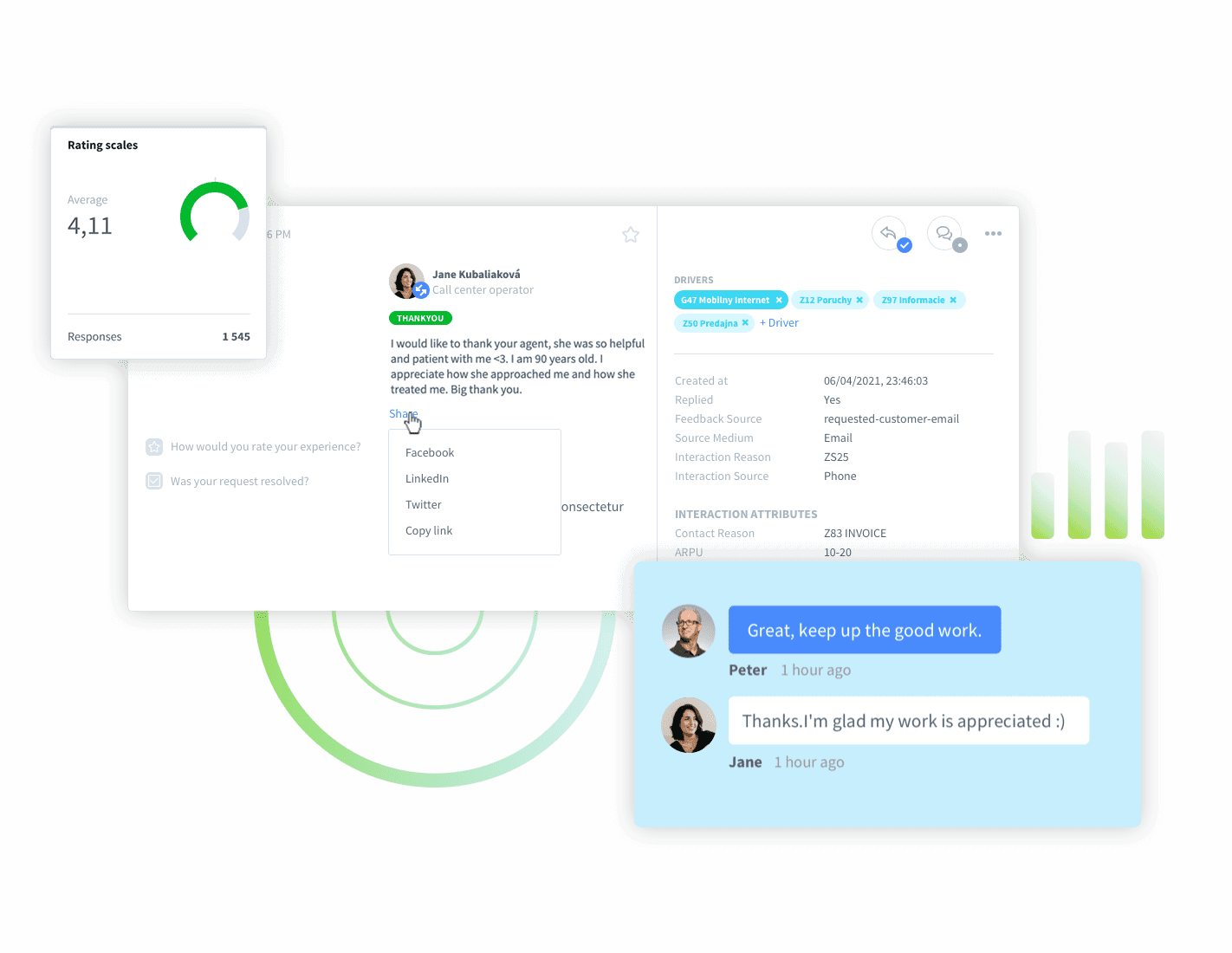
For example, instead of simply recognising an employee for “good performance”, a manager could highlight a customer comment praising how the employee handled a difficult situation.
The employee sees exactly what they did well. The manager has a concrete example to reinforce. And the organisation can identify behaviours worth replicating across the team.
Employee Recognition Can Connect Three Perspectives
A strong employee recognition process can bring together:
What the employee did → How the customer experienced it → Why it mattered to the business
This makes recognition more specific and meaningful than generic praise.
It can also become part of a broader performance management employee strategy, where feedback, coaching, recognition, and development work together.
How Can Managers Turn Employee Feedback into Better Business Outcomes?
Collecting employee feedback is only the beginning. The real value comes from identifying what employees are telling the organisation and turning those insights into action.
Suppose an employee survey shows that frontline employees feel they do not have enough authority to resolve customer problems. Customer feedback simultaneously shows repeated complaints about slow issue resolution.
These two data points reinforce each other.
The employee feedback identifies a potential internal barrier. Customer feedback shows how that barrier may be experienced externally.
Management can then investigate whether giving employees more autonomy, improving processes, or changing escalation rules could improve both employee and customer outcomes. This is where improving employee engagement to drive business performance becomes more than a slogan. Employee feedback becomes an input into operational decision-making.
What Should an Employee Performance Dashboard Include?
A useful employee performance dashboard should connect employee, customer, and operational metrics rather than overwhelming managers with isolated numbers.
For example:
Area | KPI | What it can tell managers |
Engagement | Engagement score | How connected and motivated employees feel |
Recognition | Recognition frequency | Whether positive performance is being acknowledged |
Performance | Quality score | How effectively employees meet defined standards |
Customer experience | CSAT | How customers rate their experience |
Customer loyalty | NPS | Overall customer relationship and advocacy |
Feedback | Positive/negative themes | What customers praise or criticise |
Operations | Resolution rate | How effectively customer issues are resolved |
Development | Coaching actions completed | Whether identified performance gaps are being addressed |
The goal is not to create one giant dashboard containing every available metric. It is to connect the metrics that help managers answer meaningful questions.
From Measurement to Coaching
Data becomes significantly more valuable when it leads to a clear next step. A practical coaching workflow could look like this:
- Identify a signal
Engagement drops in a particular team.
- Add context
Customer feedback shows an increase in complaints about the same team’s service.
- Investigate the cause
Employee feedback reveals that the team is struggling with a new process.
- Take action
The manager provides additional training and clarifies the process.
- Recognise progress
Employees receive recognition when customer feedback shows improvement.
- Measure the outcome
Engagement, customer satisfaction, and performance metrics are monitored over time.
This creates a continuous feedback cycle rather than a once-a-year employee performance review.
Where Do Employee Performance Management Tools Fit In?
Modern employee performance management tools can help organisations bring these processes together.

Instead of keeping engagement surveys, performance reviews, recognition, customer feedback, and operational KPIs in completely separate systems, companies can increasingly connect these data sources to create a more complete view of employee and team performance.
The role of employee performance management software is therefore expanding beyond traditional performance reviews. The most useful systems can support an ongoing cycle of:
Listen → Understand → Coach → Recognise → Measure → Improve
This also connects performance management and employee engagement with continuous employee development rather than treating them as separate HR processes.
What Is Employee Experience Management?
What is employee experience management in this context? Employee experience management is the systematic process of understanding and improving the different interactions, conditions, and processes that shape an employee’s experience at work.
It goes beyond measuring whether employees are satisfied. It looks at what employees need to perform effectively, where friction exists in their everyday work, how managers support them, and how the employee experience ultimately connects to customer and business outcomes.
This is why employee engagement should be viewed as one component of a broader employee experience strategy.
What Are the Limitations of Linking Engagement to Performance?
Connecting employee and customer data can provide valuable insights, but organisations should be careful not to assume that correlation automatically means causation.
A team with high engagement and high CSAT may have other advantages, such as stronger leadership, better staffing levels, more experienced employees, or simpler processes.
There are also privacy and fairness considerations when using employee data.
Companies should be transparent about how employee information is collected and used, avoid reducing individuals to a single score, and use data to support development rather than create unnecessary surveillance.
The objective should be to help employees and managers understand what enables better performance, not simply to rank people.
From Employee Engagement to Measurable Performance
Employee engagement becomes significantly more valuable when organisations connect it with what happens beyond the employee survey.
By combining employee feedback with recognition, performance indicators, customer feedback, NPS, CSAT, and operational data, companies can build a clearer picture of what drives performance and customer experience.

The most mature approach is not about finding one perfect employee performance management system or one universal engagement metric.
It is about creating a continuous feedback cycle where employees are heard, managers receive actionable insights, good performance is recognised, development needs are identified, and customer outcomes are monitored. That is how organisations can move from engagement to performance.
Connect Employee Engagement and Performance with Staffino
Staffino helps organisations connect employee experience with the performance and customer outcomes that matter to the business.
By bringing employee feedback, engagement measurement, recognition, and CX data together, Staffino can help managers understand not only how employees feel, but also where employee experience connects with customer experience and operational performance.
This creates a more complete foundation for employee performance management systems, one where feedback can inform coaching, customer feedback can reinforce recognition, and engagement data can support better business decisions.
The goal is simple: listen to your employees, understand what drives their performance, and use those insights to create better experiences for both employees and customers.

Get a First-Hand Experience Today!
Staffino is the perfect tool for creating engaging surveys, tracking performance, responding to customer feedback, and rewarding top employees. Get started today with our FREE demo!
FAQ
Employee engagement can influence motivation, ownership, and the quality of work, but performance also depends on factors such as leadership, training, tools, and processes. Connecting engagement data with performance metrics helps companies understand these relationships.
Engaged employees are more likely to take ownership, support customers effectively, and contribute to positive interactions. Combining employee engagement data with NPS, CSAT, and customer feedback can reveal how employee experience connects with customer experience.
Companies can combine employee performance metrics with customer feedback, CSAT, NPS, and other CX indicators. This provides additional insight into how individual or team performance is experienced by customers.
Recognition reinforces positive behaviours and helps employees understand what good performance looks like. Recognition based on real customer feedback can make it more specific, meaningful, and connected to customer outcomes.
Managers can use employee feedback to identify barriers to performance, connect them with operational or CX data, and take targeted action such as coaching, training, or process improvements. Results can then be measured over time.
Common metrics for employee engagement include engagement scores, eNPS, recognition activity, manager effectiveness, survey participation, and employee feedback. These become more useful when analysed alongside performance and CX metrics.
Employee feedback can help managers identify development needs, understand performance barriers, and create more targeted coaching plans. This makes performance management and employee development part of an ongoing feedback cycle rather than an annual process.
Staffino helps organisations connect employee feedback, engagement measurement, recognition, and customer experience data, giving managers a broader view of what influences employee and team performance.
Yes. Staffino provides tools for employee engagement, feedback, recognition, and performance-related insights, helping organisations connect employee experience with customer and business outcomes.