


Customer experience starts with listening. But collecting customer feedback is only the first step.
In Part 1 of the CX Maturity Study Romania series, we looked at the bigger picture: where Romanian organisations stand in their overall CX maturity and how customer experience is evolving across the market. Part 2 then explored the organisational foundations behind CX maturity, including strategy, culture, governance, processes, technology, and AI.
Now, in Part 3, we turn to two closely connected areas at the heart of customer experience: Voice of Customer (VoC) and Customer Journey Management.
The findings reveal a market that is getting better at listening to customers and defining the experiences it wants to deliver. But a gap remains between collecting feedback and turning it into actionable intelligence, and between designing customer journeys and systematically optimising them.
In other words, Romanian companies are making progress. The next step is making that progress more systematic.

Experience Management Made Smart
Boost your business performance with Staffino – the ultimate platform to deliver unique experiences for your customers and employees.
Voice of Customer: From Listening to Action
Between 2023 and 2025, Romanian companies improved their ability to collect, analyse, and act on customer feedback across the customer journey.
One of the clearest improvements is in how customer insights are shared throughout organisations. The score for distributing customer feedback insights in formats tailored to different roles increased from 3.2 in 2023 to 3.6 in 2025 on a 1–5 scale.

Companies also became better at closing the loop with dissatisfied customers. The score for providing detractors with responses and solutions to negative feedback rose from 3.5 to 3.7 over the same period.
There has also been progress in turning feedback into solutions. The score for following an established process for developing solutions after analysing customer feedback increased from 3.2 in 2023 to 3.4 in 2025.
These developments suggest that Voice of Customer is becoming less isolated within individual CX or customer service teams. Insights are increasingly being shared internally and connected to problem-solving.
But there is an important limitation.
The Feedback-to-Growth Gap
The overall maturity of Voice of Customer remains at a mid-level. The biggest opportunity is moving beyond using feedback primarily to fix problems and using it more actively to drive innovation and customer advocacy.

For example, the score for integrating customer feedback into the launch of new products and services was 3.6 in 2025, indicating that feedback is already playing a role in product and service development. However, advocacy remains less developed.
Although the score for targeting promoters in advocacy campaigns recovered to 3.0 in 2025 from 2.7 in 2024, the finding suggests that organisations are still under-leveraging their most loyal customers as brand advocates.
This points to a broader challenge: companies are becoming better at responding when something goes wrong, but are not yet equally effective at using positive customer experiences as a source of growth, advocacy, and differentiation.
A mature VoC programme should therefore answer two questions:
What went wrong, and how do we fix it?
But also:
What are our customers telling us about what we should build, improve, or do next?
Romanian Companies Are Listening Across More Channels
The research also shows that companies are using an increasingly broad mix of listening methods.
In 2025, 59% of organisations used continuous digital listening, giving customers opportunities to provide feedback whenever and wherever they want, such as through websites or mobile apps.

Unstructured listening, including call-centre conversations, social media posts, and online reviews, was used by 57% of companies. Frontline feedback was another important source, used by 52%. Relationship tracking, interaction feedback and behavioural tracking were also used by significant shares of organisations.
This is an important sign of progress. Companies are increasingly recognising that the Voice of Customer exists across the entire customer experience, from individual interactions to broader behavioural signals.
At the same time, one area remains comparatively underused: journey feedback. Only 26% of organisations reported asking customers for their thoughts after they have completed a specific goal or journey. That matters because understanding individual interactions is not the same as understanding the customer journey as a whole.
More Feedback, But Not Yet Enough Intelligence
The expansion of listening channels creates another challenge: how to make sense of all the feedback being collected.

In 2025, 44% of Romanian organisations said they did not use AI to analyse customer feedback at all.
Another 31% relied on simple text analysis based on keywords or rules. Only 17% used AI to identify the main themes and categories in feedback, while 15% had implemented NLP for sentiment classification.
More advanced applications were even less common. Just 13% used AI to generate reports or recommendations based on feedback, while only 9% combined feedback with other data sources for predictive analytics and another 9% had AI automation that flagged critical or urgent feedback to relevant teams.
The gap is therefore becoming clear: companies are building stronger listening capabilities faster than they are building the analytical capabilities needed to turn that feedback into intelligence. For CX teams, the next step is not necessarily collecting more data. It is making better use of the data they already have.
Meet the AI That Knows Your Customers
Staffino AI Cortex acts as a generative AI consultant for CX. It understands your feedback, identifies trends, and helps teams make smarter decisions faster.
Customer Journey: Stronger at Designing Than Optimising
The same pattern appears in Customer Journey Management.
Romanian companies are relatively mature when it comes to defining customer segments and personas and articulating the experience they want to deliver. In 2025, defining customer personas scored 3.6 out of 5, while defining the desired or expected customer experience scored 3.4.
The challenge is what happens next.
The score for having KPIs for individual customer interaction points increased significantly, from 2.6 in 2024 to 3.1 in 2025. Companies also improved their measurement of customer satisfaction after implementing a new interaction, reaching 3.0 in 2025 compared with 2.8 in 2023.
These are positive developments, but some capabilities are still emerging. Personalised communication tailored to customer segments remains only moderately developed, while having employees regularly test customer experiences themselves remains the least-used practice measured in this area.
The result is a clear execution gap:
Romanian companies increasingly know who their customers are and what experience they want to deliver. They are still developing the discipline to systematically measure, test and optimise those journeys end-to-end.
STEFAN DUMITRU
REGIONAL MANAGER, STAFFINO
Customer Journey Mapping Is Common. Journey Management Is Harder.
The tools and methodologies organisations use for customer journey work reinforce this point.
Customer Journey Maps are used by 52% of organisations, making them the most common methodology for process design in customer interactions. Design Thinking follows at 33%. However, 36% of companies reported that they do not use any of the listed methodologies.
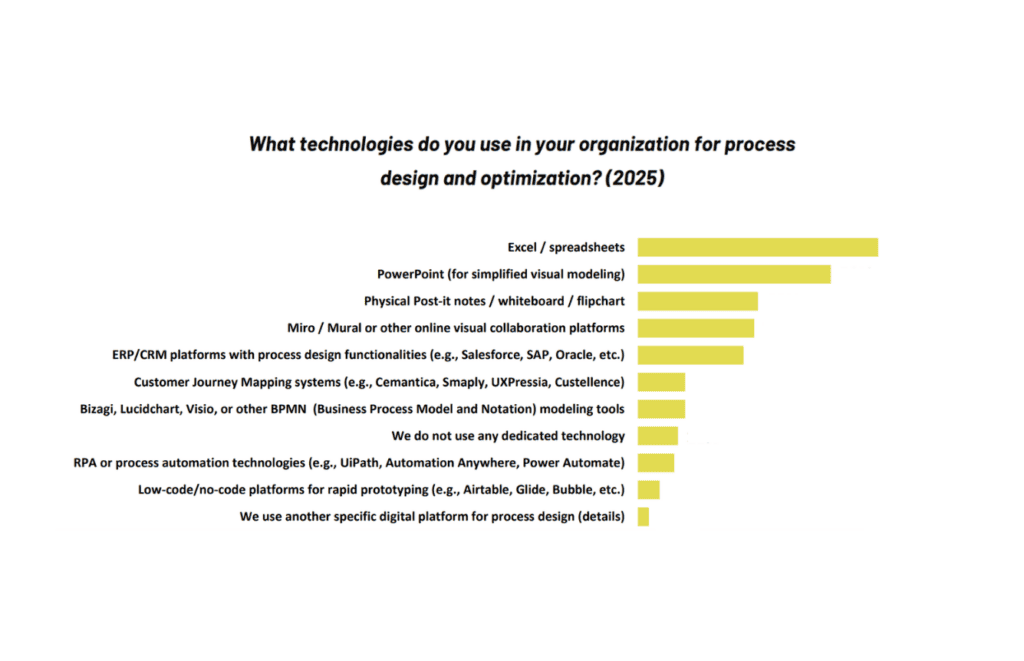
There is also a significant technology gap. While 66% use Excel or spreadsheets and 53% use PowerPoint for process design and optimisation, only 13% use dedicated customer journey mapping systems.
This creates a disconnect between design and operationalisation.
A journey map can provide an excellent view of the customer experience, but if it lives in a static spreadsheet or presentation, keeping it updated and translating changes into operational processes becomes much harder.
Jan gabauer
Lead Senior XM Auditor & Consultant, STAFFINO
The next stage of maturity is therefore not simply creating better journey maps. It is moving towards dynamic journey management, where customer journeys can be continuously updated, connected to processes and used to drive action across the organisation.
What B2C Customers Will Expect Next
The study also identifies some clear priorities for the B2C sector in 2026.
The biggest opportunity identified by B2C organisations is online self-service, cited by 28%. Other priorities include helping customers choose the right product or service (26%), purchasing the product (24%), and learning about a new product (24%).
The common thread is autonomy.
Customers increasingly expect to find information, make decisions, complete transactions and solve straightforward problems without unnecessary friction or dependence on a human agent.
For B2C companies, this means digitalisation should not simply replicate existing processes online. The opportunity is to redesign journeys around what customers actually need: speed, clarity, simplicity and control.
From Customer Feedback to Better Journeys
The findings across Voice of Customer and Customer Journey Management point to the same broader challenge.

Romanian organisations are listening more widely, sharing customer insights more effectively and becoming better at defining their customer journeys. But the next level of CX maturity requires them to connect these capabilities.
Customer feedback should not end with a report. It should influence how journeys are designed. Customer journeys should not end with a map. They should be continuously measured and improved. And the growing volume of customer data needs to become actionable intelligence, supported by stronger analytics and AI CX capabilities.
The most mature organisations will be the ones that can connect all three:
Listen to customers → understand what the feedback means → improve the journey.
What Does This Mean for CX Maturity in Romania?
The 2025 findings show meaningful progress, but also a clear next step for Romanian organisations.
The market is moving from collecting feedback towards acting on it, and from mapping customer journeys towards measuring them. The opportunity now is to close the gaps between listening, analysis, decision-making and execution.
For organisations looking to benchmark their own CX maturity, the full CX Maturity Study Romania provides a much broader view of where the market stands across these capabilities and others.
Want to Explore the Full Findings?
This article highlights just some of the findings from the comprehensive study conducted by Staffino in collaboration with Customer Experience Romania. The full research goes deeper into the data, trends, and CX maturity of Romanian organisations.
Want to see where your organisation stands?
Get the complete CX Maturity Study Romania directly from the Customer Experience Romania e-shop, or contact the Staffino sales team at [email protected] to obtain the study and discuss how its findings can support your CX strategy.
And this is not the end of the series. Part 4 will turn the focus inward, exploring the employee journey and the role of employee experience in CX maturity. We’ll look at how Romanian organisations approach the employee journey and where there are opportunities to strengthen the connection between EX and CX.
Be the first to know when the next Staffino article goes live—subscribe to our newsletter!