


Customer survey fatigue occurs when customers become less willing to respond to surveys due to excessive frequency, poor timing, or irrelevant questions. It leads to declining survey engagement, lower completion rates, and reduced data quality. Understanding how to reduce survey fatigue is essential for maintaining a high survey response rate and collecting reliable customer insights.
Customer feedback is essential for improving experience, but many companies face a growing challenge: declining participation. Customer survey fatigue is becoming one of the main reasons behind a low survey response rate, reduced data quality, and increasing survey abandonment.
When customers are repeatedly asked for feedback, or when surveys are too long, poorly timed, or irrelevant, they stop engaging. In this article, we explain what survey fatigue is, what causes it, how to avoid survey fatigue, and how businesses can effectively improve survey response rate and maintain meaningful survey engagement over time.

Transform Your Customers' Experiences
Create a bulletproof customer journey with tailored CX products and services that will foster loyalty and reduce churn.
What Is Survey Fatigue?
Survey fatigue refers to the decreasing willingness of customers to respond to surveys due to overexposure or poor survey experiences. It often leads to respondent fatigue, lower completion rates, and less reliable feedback data.
In practice, customer survey fatigue occurs when customers are repeatedly asked for input without seeing clear value or when surveys become too frequent or too demanding. As a result, both CSAT survey response rate and NPS survey response rate tend to decline over time.
What Causes Customer Survey Fatigue?

There are several key survey fatigue causes that directly impact engagement:
One of the most common is excessive survey frequency. When customers receive too many requests in a short period, they begin to ignore them altogether.
Another major factor is poor survey design. Long, repetitive, or unclear questionnaires increase frustration and lead to survey abandonment. Similarly, irrelevant questions reduce perceived value and negatively affect survey completion rate.
Timing also plays a critical role. Weak survey timing best practices, such as sending surveys long after the interaction, reduce relevance and lower response rates.
Other common issues include:
- Lack of personalisation in questions
- Poor mobile experience and non-mobile-friendly surveys
- No visible action taken on previous feedback
- Overuse of generic, repetitive survey templates
All of these contribute to declining customer survey response rates and reduced data quality.
How Can Businesses Avoid Survey Fatigue?
To understand how to reduce survey fatigue, businesses need to focus on relevance, timing, and user experience.
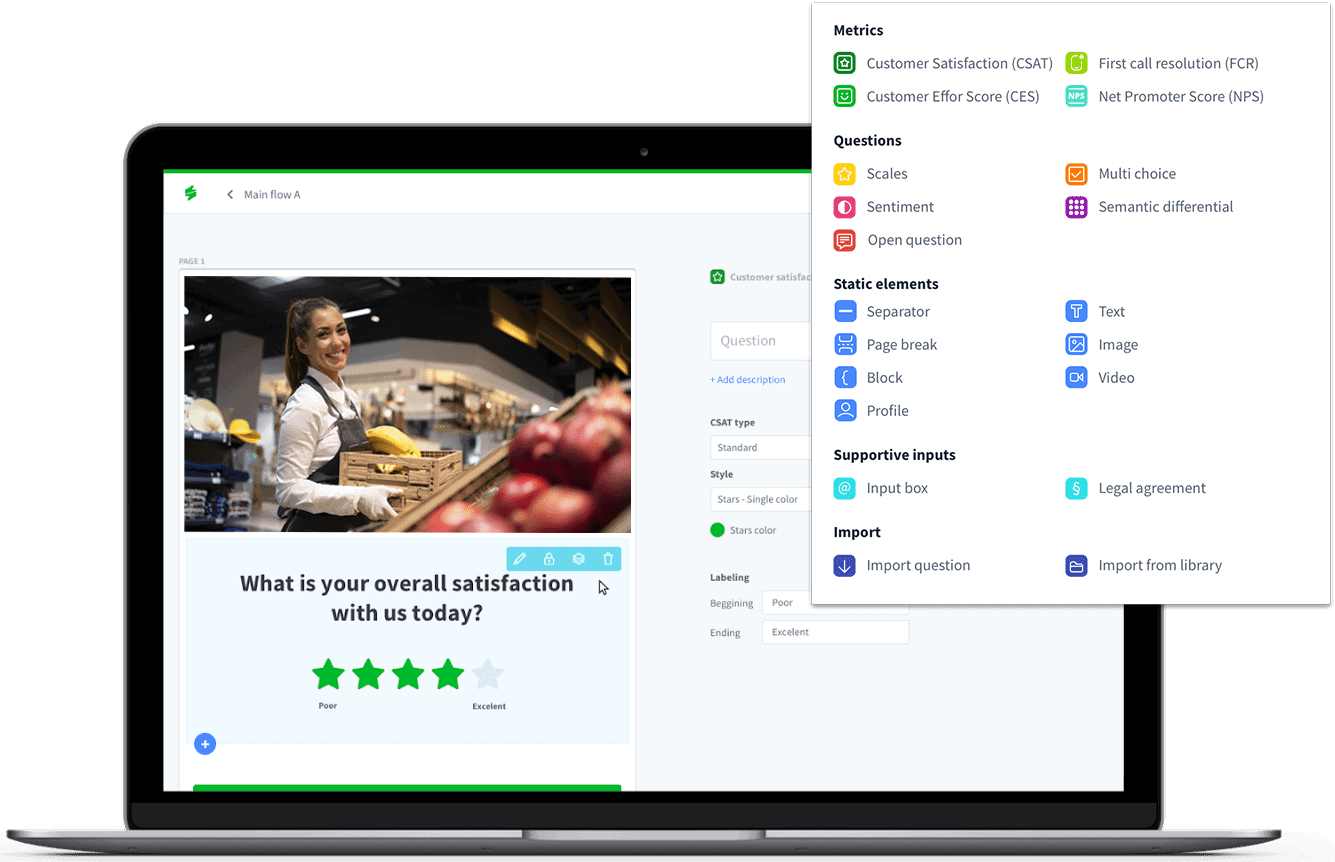
First, optimise customer survey frequency. Instead of sending multiple surveys per customer journey, prioritise key touchpoints and reduce unnecessary interruptions.
Second, follow strong survey design best practices. Surveys should be short, clear, and focused only on essential questions. This directly improves survey engagement.
Third, ensure mobile-friendly surveys. Since most customers respond on mobile devices, poor usability significantly lowers completion rates.
Fourth, improve survey timing. Sending surveys immediately after an interaction (when the experience is still fresh) improves relevance and increases the likelihood of responses.
Finally, demonstrate action. When customers see that their feedback leads to real improvements, survey engagement naturally increases. This is also called closing the feedback loop.

Get Actionable Insights with Closed Loop Feedback Management
With Staffino, you'll never leave a customer unhappy again! Streamline the process of collecting and responding to feedback, identify areas of improvement, and make sure that customer issues are addressed quickly and effectively.
How Can Businesses Increase Survey Response Rates?
How to increase survey response rates? It requires a combination of optimisation strategies across timing, design, and communication.
Personalisation is key. Tailored surveys based on customer behaviour or interaction history significantly improve survey response rate and reduce friction.
Keeping surveys short also has a direct impact on survey completion rate. The shorter the survey, the higher the likelihood of completion.
Businesses should also actively monitor survey response rate best practices, such as:
- Using clear and simple language
- Avoiding redundant questions
- Prioritising key CX metrics only
Another important factor is demonstrating value. When customers understand that their input improves services, the customer survey response rate increases over time.
Finally, optimising across channels helps. Well-designed mobile-first experiences and seamless digital journeys reduce friction and support higher engagement.
Explore our industry-specific survey templates, designed to maximise survey response rates and customer engagement.
Survey Timing Best Practices: How Often Should Companies Send Customer Surveys?
When it comes to survey timing best practice, there is no universal rule, but frequency must be carefully balanced to avoid customer survey fatigue.
If surveys are too frequent, they increase respondent fatigue and reduce participation. If they are too rare, businesses miss valuable insights.
Jan gabauer
Lead Senior XM Auditor & Consultant
The best approach depends on context:
- Transactional surveys (e.g., CSAT survey) should be sent immediately after interactions.
- Relationship surveys (e.g., NPS survey) should be spaced out to avoid over-contact.
- Pulse surveys should be used sparingly and strategically.
Good survey timing ensures that feedback is collected when it is most relevant, without overwhelming customers. Ultimately, companies that respect customer attention and avoid over-surveying consistently achieve a higher survey response rate and more reliable insights.
Achieve Higher Survey Response Rates with Staffino
Reducing customer survey fatigue and improving survey engagement requires more than just shorter questionnaires. It demands smarter timing, better targeting, and continuous optimisation based on real customer behaviour.
Staffino helps businesses implement survey response-rate best practices by delivering highly targeted, context-aware feedback collection across the entire customer journey. With intelligent automation, personalised CX surveys, and optimised survey timing, our clients significantly improve survey response rate while reducing survey abandonment.
By combining advanced analytics with seamless feedback collection, Staffino enables organisations to better understand customers without overwhelming them, resulting in higher-quality insights and stronger customer survey response rate performance.
If you want to reduce survey fatigue and turn feedback into action, Staffino helps you do exactly that, at scale.
Get a First-Hand Experience Today!
Staffino is the perfect tool for creating engaging surveys, tracking performance, responding to customer feedback, and rewarding top employees. Get started today with our FREE demo!
FAQ
Survey fatigue is the decline in willingness to respond to surveys caused by overexposure, repetitive questions, or poorly designed feedback requests.
Common causes include excessive survey frequency, long or repetitive questionnaires, irrelevant questions, poor timing, and a lack of visible action on feedback.
Businesses can avoid survey fatigue by reducing survey frequency, improving survey design, keeping surveys short, and ensuring feedback is relevant and well-timed.
Improving survey clarity, optimising timing, personalising questions, and using mobile-friendly formats all help increase survey response rates.
Survey frequency depends on the type of feedback. Transactional surveys (e.g. CSAT) should be sent after each key interaction, while relationship surveys (e.g. NPS) are typically sent quarterly or biannually. Pulse surveys can be used more flexibly, but should remain occasional to avoid over-surveying. In all cases, businesses should focus on meaningful customer touchpoints to avoid fatigue.
Staffino is a customer experience platform designed to improve survey response rates through smart targeting, optimised timing, and engaging, mobile-friendly surveys.
Staffino improves survey response rates by automating survey distribution at the right moments and ensuring feedback is relevant, short, and easy to complete. In addition, our seasoned CX experts are available to support businesses in designing effective surveys and optimising feedback strategies to maximise engagement.