


Customer experience automation helps businesses collect, analyse, route and act on customer feedback with less manual work. By combining workflow automation with AI, companies can identify customer issues faster, prioritise what needs attention and support employees with the right information at the right time. The goal is not to automate every customer interaction, but to automate repetitive processes so teams can spend more time on the situations where human judgement matters most.
In this article, we look at what customer experience automation actually involves, which parts of CX can be automated, how AI can analyse and route customer feedback, where AI agents and generative AI fit into the picture, and what businesses should consider before automating too much. We’ll also look at how to balance automation with the human touch and measure whether it is actually improving the customer experience.

Let AI Handle the Heavy Lifting in CX
With Staffino’s AI, you can respond with empathy at scale, understand customer feedback faster, boost upsell, and make smarter decisions with almost no effort.
What Is Customer Experience Automation?
Customer experience automation is the use of technology to automate repetitive processes across the customer journey and CX management. This can include collecting feedback, analysing customer comments, identifying topics and sentiment, routing issues to the right teams, generating reports and triggering follow-up actions.
Traditional automation typically relies on predefined rules. For example, feedback containing a specific keyword might automatically be assigned to a particular team. More advanced customer experience automation uses AI to understand the context of customer feedback and make decisions based on what customers are actually saying.
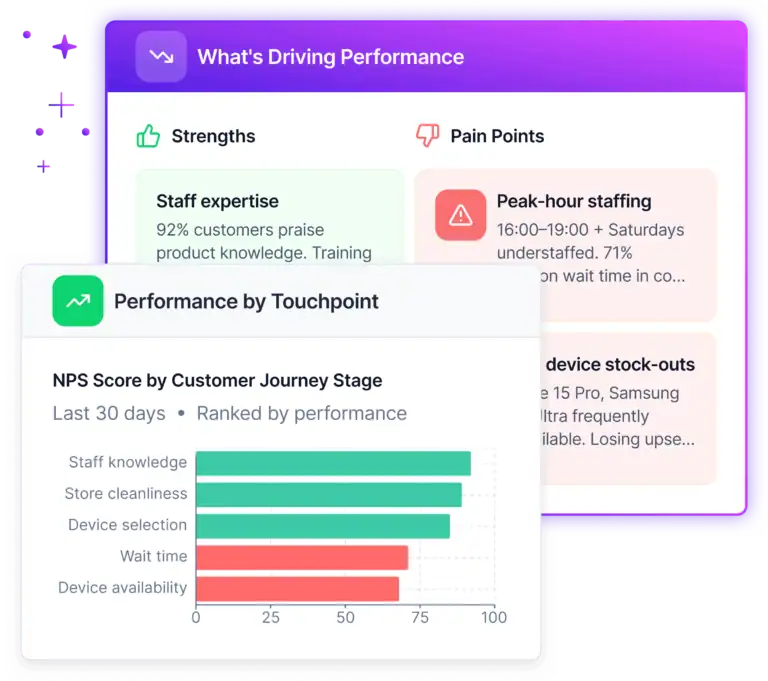
This changes what automation customer experience teams can handle. Instead of simply moving information from one system to another, AI can help interpret unstructured customer data and identify what deserves attention.
The difference is important:
Traditional automation:
“If X happens, do Y.”
AI-powered automation:
“Understand what is happening, determine what matters and recommend or trigger the appropriate next step.”
That makes automation and customer experience increasingly connected. The more customer data businesses collect, the more difficult it becomes to analyse and act on it manually.
Which Parts of Customer Experience Management Can Be Automated?
Not every part of CX should be automated. However, many repetitive processes around customer experience can be.
CX process | What automation can do |
Feedback collection | Trigger customer surveys and collect feedback across channels |
Feedback analysis | Identify topics, sentiment, trends and recurring issues |
Categorisation | Automatically classify feedback according to predefined or AI-generated topics |
Feedback routing | Send specific cases to the right team or person |
Prioritisation | Identify urgent or high-impact feedback |
Reporting | Generate summaries and recurring reports |
Alerts | Notify teams when important issues or changes emerge |
Response support | |
Follow-up | Trigger actions based on feedback or case status |
The key is to distinguish between automating a process and automating a decision.
Automating the collection of thousands of customer comments can save considerable time with relatively little risk. Automatically deciding how to handle a sensitive complaint is a different matter.
A strong customer experience automation strategy therefore combines automation with appropriate human oversight.
How Does AI Automate Customer Feedback Analysis?
Customer feedback often contains information that is difficult to process with simple rules. Customers do not necessarily use the same words to describe the same problem, and a single comment can contain several topics or different emotions.
This is where AI customer feedback analysis can add value.
AI can analyse feedback from surveys, reviews, contact centres and other customer interactions to identify:
- recurring topics and issues
- positive and negative sentiment
- changes in sentiment over time
- specific aspects of the customer experience
- emerging problems
- patterns across locations, products or customer segments
- feedback that may require immediate attention
For example, a customer might write that an order arrived quickly but that the delivery driver was unhelpful and the packaging was damaged. A basic system might classify the entire comment as either positive or negative. An AI-powered system can recognise that the feedback contains several separate signals: fast delivery, poor interaction with the driver and damaged packaging.
This allows CX teams to move beyond simply asking whether customers are satisfied. They can see what is driving the experience and where action may be needed.
How Can Automated Feedback Routing Improve Response Time?
Once feedback has been analysed, the next challenge is deciding what should happen to it.
Without automation, customer feedback can sit in inboxes, spreadsheets or dashboards until someone reviews it. This creates a gap between the moment a customer raises an issue and the moment the business responds.

Automated feedback routing can shorten that gap and close the feedback loop faster.
A typical workflow might look like this:
Customer feedback → AI analysis → topic and urgency detection → routing → employee action → resolution → monitoring
For example, feedback about a payment problem could automatically be routed to the relevant banking support team, while feedback about a store-level issue could go directly to the appropriate location manager. Automation can also help prioritise cases. Not every piece of feedback needs an immediate response, but certain signals may deserve faster attention.
This allows teams to focus their time where it can have the greatest impact rather than manually sorting every incoming comment.
How Are AI Agents and Copilots Used in Customer Service Automation?
AI is also changing the role of automation in customer service.
An AI agent for customer service automation can perform a sequence of tasks based on a goal rather than simply executing one predefined action. Depending on the system and permissions, this could include understanding a customer request, retrieving relevant information, taking an action and escalating the situation when necessary.

AI copilots take a more assistive approach. AI copilot agents for customer service automation can support employees by summarising conversations, finding relevant information, suggesting responses or recommending the next step.
The distinction between the two is important.
AI copilots support people. They help employees make decisions and complete tasks faster while leaving the final decision with the human.
AI agents can perform actions more independently. They may handle defined workflows without requiring an employee to initiate every individual step.
Neither approach means that every customer interaction should become fully automated.
For routine, predictable processes, automation can be highly effective. For complex complaints, sensitive situations or decisions with significant consequences, human involvement remains essential.
What Are Customer Experience Automation Platforms?
Customer experience automation platforms bring several of these capabilities together instead of requiring teams to manage each process separately.
A customer experience automation platform may combine feedback collection, AI analysis, workflow automation, routing, reporting and alerts in one environment.
When evaluating such a platform, businesses should look beyond the number of automated features. The more important question is whether the platform helps the organisation move from customer feedback to action.
Useful capabilities can include:
- collecting feedback across multiple channels
- AI-powered topic and sentiment analysis
- automated categorisation
- configurable workflows
- feedback routing
- prioritisation and alerts
- integrations with existing systems
- AI-generated summaries and recommendations
- reporting and trend monitoring
- human approval and escalation options
A platform should also make it possible to understand whether automation is actually improving the customer experience.
Meet the AI That Knows Your Customers
Staffino AI Cortex acts as a generative AI consultant for CX. It understands your feedback, identifies trends, and helps teams make smarter decisions faster.
Robotic Process Automation vs AI-Powered CX Automation
Robotic process automation (RPA) has been used for years to automate repetitive, rule-based processes. In a customer experience context, RPA can be useful for tasks such as transferring information between systems, updating records or triggering predefined workflows.
However, RPA generally works best when the process and its inputs are structured and predictable.
Customer feedback is rarely like that. Customers use different words, express multiple emotions and describe situations in ways that cannot always be anticipated in advance. This is where AI-based automation can complement traditional RPA.
Rather than simply following a fixed rule, AI can interpret unstructured information and identify patterns that were not explicitly defined beforehand. This means robotic process automation customer experience workflows and AI do not necessarily compete with each other. They can work together:
AI understands the customer signal. RPA or workflow automation helps execute the next step. For example, AI could identify a customer complaint about a specific product issue, while an automated workflow creates the appropriate case and routes it to the responsible team.
How Does Generative AI Support Customer Experience Automation?
Generative AI adds another layer to automation by allowing systems to create useful outputs from customer data.
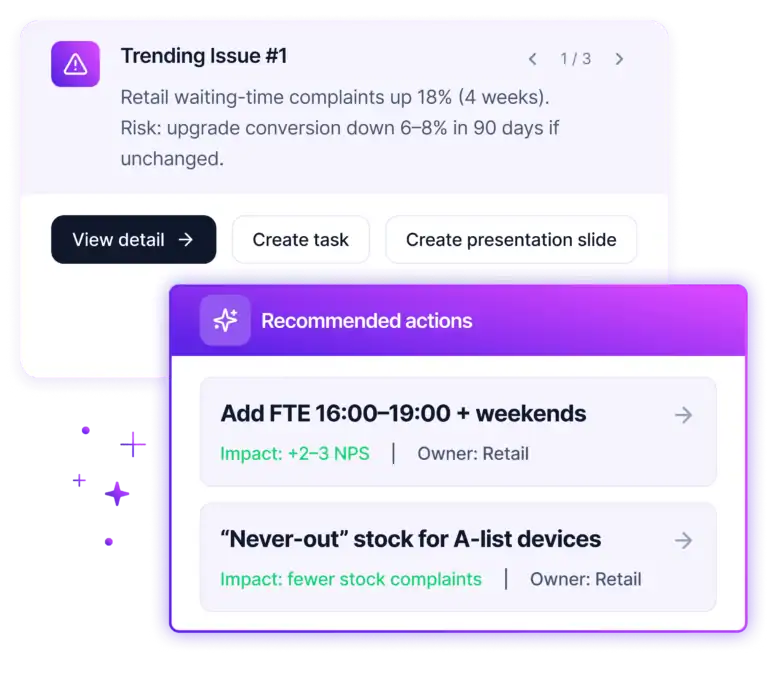
Generative AI for customer experience can be used to summarise large volumes of feedback, generate response suggestions, explain emerging trends and turn complex customer data into more accessible insights.
Instead of asking an employee to manually read hundreds of comments and write a summary, generative AI can produce an initial overview that highlights the most important themes. It can also help employees understand what is happening faster.
For example:
Without generative AI:
An analyst reviews feedback → identifies patterns → creates a summary → prepares a report → shares recommendations.
With generative AI:
AI analyses feedback → summarises key patterns → highlights emerging issues → suggests areas to investigate → employee validates and acts.
This does not eliminate the analyst’s role. It changes where their time is spent. Rather than spending hours preparing information, they can spend more time evaluating it, deciding what matters and determining what the organisation should do next.
What Should Businesses Automate in CX?
A useful starting point is to look at the characteristics of the process rather than simply asking whether it can be automated.
Automate Repetitive Tasks
Processes that are high-volume, repetitive and rules-based are often good candidates for automation. Examples include:
- collecting and organising feedback
- tagging and categorising comments
- generating recurring reports
- sending notifications
- routing standard cases
Use AI to Assist with Interpretation
AI is particularly useful when large volumes of unstructured information need to be understood. Examples include:
- identifying topics
- analysing sentiment
- summarising feedback
- detecting patterns
- prioritising potential issues
- generating response suggestions
Keep Humans Involved in High-Impact Decisions
Human judgement is especially important when situations involve:
- sensitive complaints
- vulnerable customers
- complex escalations
- exceptions to standard processes
- significant financial or reputational consequences
- strategic CX decisions
The goal is not maximum automation. The goal is the right level of automation for each process.
What Are the Risks of Over-Automating Customer Experience?
Automation can make CX teams faster and more efficient, but automating the wrong processes can create new problems.
1. Losing the Human Context
Customers are not always predictable. A system may correctly identify the topic of a complaint while missing why the situation matters to the customer.
2. Incorrect AI Outputs
AI can misunderstand ambiguous feedback or produce an inaccurate summary or recommendation. Human validation remains important, particularly when the consequences of a decision are significant.
3. Impersonal Customer Interactions
Automating every response can make customer service feel generic. Customers may accept automation for simple tasks but expect a human when they have a complex or emotional problem.
4. Privacy and Security
Customer data needs to be handled appropriately throughout the automation process. Businesses should understand where customer information is processed, who can access it and how AI systems use it.
5. Automating a Broken Process
Automation does not automatically improve a bad process. If a customer journey is unnecessarily complicated, simply automating the existing workflow can make the inefficient process faster rather than better.
This is why businesses should first understand the customer journey and identify the source of friction before deciding what to automate.
How Can Businesses Keep the Human Touch in an Automated CX Strategy?
The strongest approach is not human vs. automation. It is human + automation. Automation can handle the volume and repetitive work. People provide judgement, empathy, context and accountability.
A practical framework is to divide CX activities into three categories:
Automate | AI-assisted | Keep human |
Feedback collection | Sensitive complaints | |
Data processing | Feedback prioritisation | Complex escalations |
Categorisation | Trend interpretation | Strategic decisions |
Routine routing | AI summaries | High-impact decisions |
Recurring reporting | Recommendations | Empathy-driven interactions |
This approach allows businesses to increase efficiency without removing people from the parts of CX where they create the most value.
How Should Businesses Measure Customer Experience Automation?
Automation should not be measured simply by counting how many processes have been automated. The more useful question is: what changed because of the automation?
Depending on the use case, businesses can track:
- customer response time
- case resolution time
- feedback response rate
- feedback coverage
- CSAT and NPS
- number of issues identified
- time spent on manual analysis
- employee productivity
- escalation rates
- resolution rates
- recurring issue frequency
For example, if AI reduces the time required to analyse customer feedback by 80% but the organisation does nothing differently with those insights, the automation has limited CX value.
The real impact comes when faster analysis leads to faster decisions, earlier intervention and better customer outcomes.
What Does the Future of Customer Experience Automation Look Like?
Customer experience automation is moving beyond simple task automation.
Earlier generations of automation focused primarily on predefined workflows: collect information, move it somewhere else and trigger an action. AI makes it possible to add interpretation to that workflow.
The emerging model looks more like:
Collect → understand → prioritise → recommend → act → measure → learn
This is where generative AI customer experience applications become particularly interesting. Instead of using AI only to analyse what has already happened, businesses can increasingly use it to identify what deserves attention and support decisions about what to do next.

AI agents may eventually handle increasingly complex workflows, while AI copilots will continue to support employees with information and recommendations.
But the human role is unlikely to disappear. As automation takes over more repetitive work, human judgement can become even more important for complex customer situations and strategic CX decisions.
The competitive advantage will not necessarily come from having the most automation. It will come from knowing where automation genuinely improves the customer experience and where a human should remain in control.
How Staffino Uses AI to Automate Customer Experience Management
Staffino combines customer feedback analysis with AI-powered insights to help CX teams spend less time processing feedback and more time acting on it.
Instead of relying solely on traditional dashboards and periodic reporting, Staffino can help teams identify what is happening in customer feedback, which topics deserve attention and where emerging issues or opportunities may be developing.
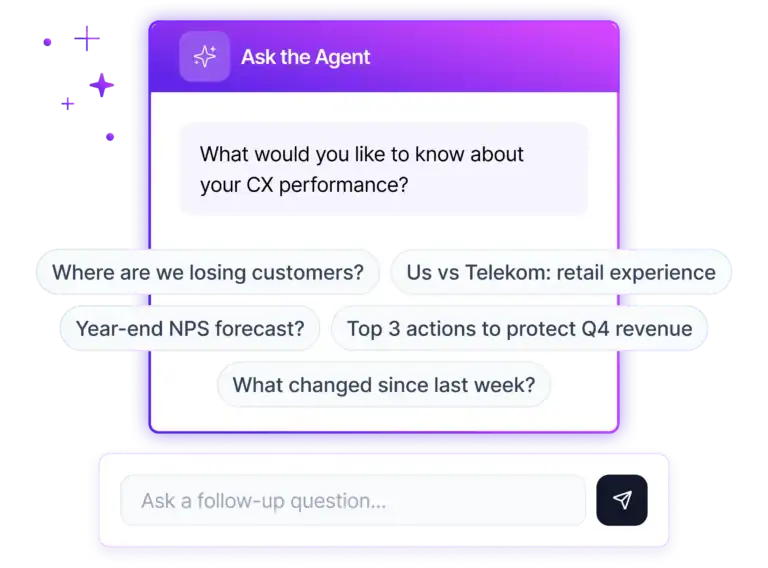
AI Cortex acts as a 24/7 CX Consultant powered by AI, helping teams move from raw feedback and dashboards towards actionable CX insights. This can include identifying emerging friction points, analysing topics and sentiment, surfacing patterns and helping teams understand where action may be needed.
The purpose of Staffino’s AI is not to remove CX professionals from the process. It is to give them better information faster, so they can focus their time on decisions and improvements that require human judgement.
Improve CX with the Right Level of Automation
Customer experience automation can remove hours of repetitive work, accelerate feedback analysis and help businesses respond to customer issues faster.
But effective automation is not about replacing human interaction wherever possible.
It is about identifying the processes where technology can do the heavy lifting—collecting information, analysing feedback, spotting patterns, routing cases and preparing insights—while leaving people in control of the decisions and interactions that require context and empathy.
When AI, automation and human expertise work together, customer experience teams can move from simply processing feedback to acting on it faster.
Want to see what AI-powered CX automation could look like for your organisation? Explore how Staffino can help you turn customer feedback into actionable insights and faster decisions.
Experience Management Made Smart
Boost your business performance with Staffino – the ultimate platform to deliver unique experiences for your customers and employees.
FAQ
Customer experience automation is the use of technology to automate repetitive CX processes such as feedback collection, analysis, categorisation, routing, reporting and follow-up. AI can extend these capabilities by interpreting customer feedback and identifying patterns or issues that require attention.
Businesses can automate feedback collection, categorisation, sentiment and topic analysis, feedback routing, reporting, alerts and some follow-up processes. AI can also assist with prioritisation, summaries, recommendations and response suggestions.
AI can analyse large volumes of structured and unstructured customer feedback to identify topics, sentiment, recurring issues, trends and emerging problems. This allows CX teams to understand feedback faster and focus on the areas that require action.
Automated feedback routing can analyse incoming feedback, identify its topic or urgency and send it directly to the appropriate team or employee. This reduces manual sorting and helps ensure that important customer issues reach the right people faster.
Over-automation can lead to impersonal interactions, incorrect AI decisions, loss of human context, privacy risks and poor handling of complex or sensitive situations. Businesses should combine automation with human oversight where judgement and empathy are important.
CX automation covers a broader range of processes across the customer experience, including feedback collection, analysis, reporting and improvement. Customer service automation focuses more specifically on automating customer support interactions and service workflows.
AI can automate or assist with many CX management processes, including feedback analysis, prioritisation, reporting, routing and response suggestions. However, strategic decisions, complex customer situations and sensitive interactions still benefit from human involvement.
An AI agent can perform a sequence of customer service tasks with a degree of autonomy, such as understanding a request, retrieving information, taking a permitted action and escalating the case when needed. Its level of autonomy depends on the workflow and safeguards defined by the organisation.
Customer experience automation platforms combine tools such as feedback collection, AI analysis, workflow automation, routing, alerts and reporting. They help businesses connect customer signals with the processes and teams responsible for acting on them.
Yes. Staffino uses AI-powered feedback analysis, insights, alerts and workflows to help CX teams identify what matters in customer feedback and act on it faster. Its AI Cortex solution works as a 24/7 CX Consultant powered by AI, helping teams move from feedback analysis towards actionable CX insights.