
Generative AI is changing customer experience management by helping businesses analyse feedback faster, automate routine CX tasks, generate response suggestions, and identify opportunities for improvement. Instead of relying solely on manual analysis and predefined rules, AI can process large volumes of customer data, understand context, and turn unstructured feedback into actionable recommendations.
For CX teams, using generative AI in customer experience management means less time spent sorting through data and more time focused on improving the experiences that matter most.
In this article, we explore how AI in customer experience management is changing the way businesses collect and analyse customer feedback, automate CX processes, identify risks, and make better decisions.
What Is Generative AI in Customer Experience Management?
Generative AI refers to artificial intelligence that can create new content based on patterns it has learned from existing data. In customer experience management, this includes generating summaries, response suggestions, recommendations, reports, and other outputs based on customer interactions and feedback.
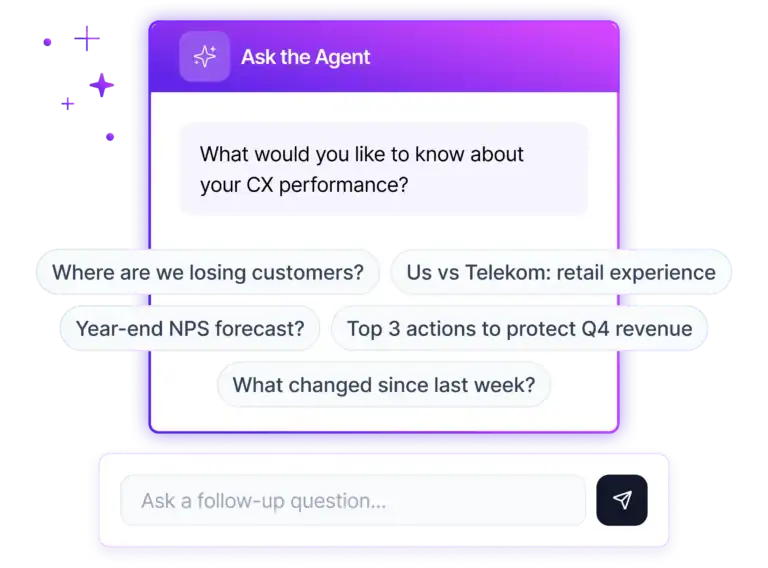
Traditional CX systems typically rely on predefined rules, CX dashboards, and structured data. Generative AI adds another layer: it can interpret large amounts of unstructured information and turn it into human-readable insights.
For example, instead of asking a CX analyst to manually review thousands of customer comments, an AI system can summarise the main issues, identify emerging themes, explain changes in customer sentiment, and highlight areas that require attention.
This is one of the reasons AI customer experience management is becoming an increasingly important part of modern CX strategies.

Let AI Handle the Heavy Lifting in CX
With Staffino’s AI, you can respond with empathy at scale, understand customer feedback faster, boost upsell, and make smarter decisions with almost no effort.
How Is Generative AI Changing Customer Experience Management?
The impact of AI on customer experience management goes beyond automating individual tasks. It is changing how CX teams understand customers, prioritise problems, and decide where to focus their efforts.
Generative AI can help organisations move from:
Collecting feedback → analysing feedback → reporting findings
to a more continuous process:
Collecting feedback → understanding what is happening → identifying what matters → recommending action → measuring the outcome
This shift makes CX management more proactive. Instead of discovering a problem weeks after it appears in a monthly report, AI can identify emerging patterns much earlier and help teams decide what should happen next.
Traditional CXM vs. AI-powered CXM
Traditional CX management | AI-powered CX management |
Manual feedback analysis | Automated feedback analysis |
Periodic reporting | Continuous monitoring |
Rule-based categorisation | Context-aware topic and sentiment detection |
Manual response creation | |
Reactive problem identification | Early detection of emerging issues |
Analysts identify trends | AI identifies patterns and opportunities |
Separate data sources | Insights consolidated across feedback channels |
Human-led prioritisation | AI-assisted prioritisation |
AI does not eliminate the need for CX professionals. Instead, it changes where their time and expertise are most valuable.
Which CX Tasks Can Generative AI Automate?
Generative AI can support a wide range of customer experience management activities. The most valuable applications are typically those involving large amounts of unstructured data or repetitive manual work.
Customer Feedback Summarisation
CX teams often have access to thousands of customer comments but limited time to read them individually.
Generative AI can summarise large volumes of feedback and highlight the most important themes, helping teams understand what customers are saying without manually reviewing every response.
For example, instead of reading 5,000 comments about a retail experience, a CX manager could receive a summary showing that customers are increasingly mentioning long queues, staff availability, and product availability.
Topic and Sentiment Detection
AI topic and sentiment analysis can automatically identify what customers are talking about and how they feel about those topics.

Rather than assigning one overall sentiment to an entire comment, advanced systems can connect sentiment to individual aspects of the customer experience. A customer might praise an employee while simultaneously criticising delivery times.
This gives CX teams a much more detailed understanding of the issues driving satisfaction or dissatisfaction.
Automated Response Suggestions
Generative AI can also help customer service teams respond to feedback more quickly.
Based on the content and sentiment of a customer comment, AI can suggest an appropriate response that employees can review, edit, and personalise before sending.
The goal isn’t to remove humans from the conversation. It is to reduce the time spent drafting routine responses while allowing employees to focus on more complex or sensitive cases.
Churn-Risk Detection
AI can identify patterns in customer feedback that may indicate increasing dissatisfaction or potential churn.
Repeated complaints, increasingly negative sentiment, unresolved issues, or changes in customer behaviour can all provide signals that a relationship may be at risk.
By bringing these signals together, AI can help teams intervene earlier rather than waiting until a customer has already decided to leave.
CX Recommendations
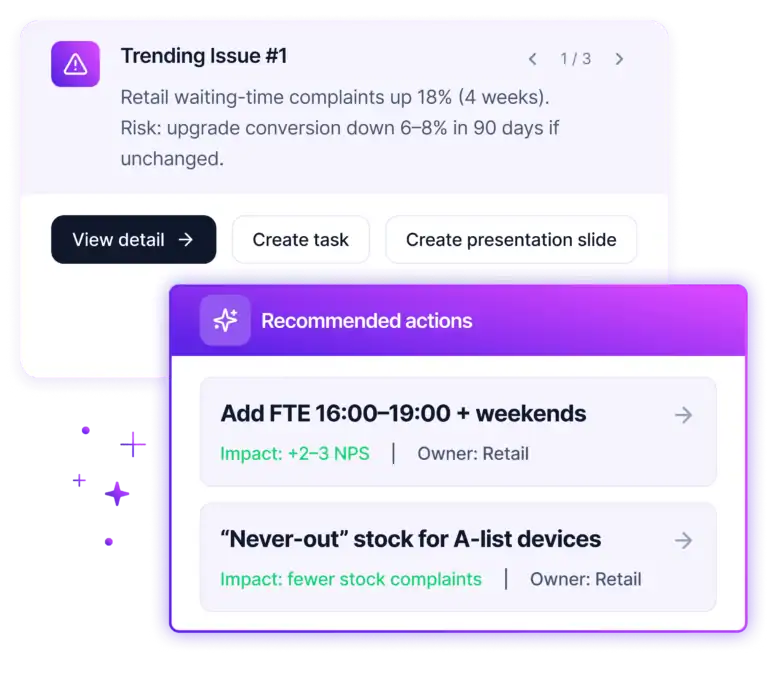
One of the most interesting developments in AI innovations in customer experience management is the shift from simply identifying problems to recommending what businesses should do about them.
For example, AI might identify a recurring complaint about a particular stage of the customer journey and suggest investigating the relevant process, location, product, or communication.
This moves CX analytics closer to decision support: not only What are customers saying?, but also What should we look at next?
Automated Reporting
Generating recurring CX reports can consume significant amounts of analyst time.
Generative AI can turn structured CX data into summaries that explain key changes, emerging trends, and areas requiring attention. This makes insights easier to communicate to managers and executives without requiring every stakeholder to interpret complex dashboards themselves.
How Can Generative AI Improve Customer Feedback Analysis?
Customer feedback is one of the areas where generative AI can have an immediate impact.
Traditional feedback analysis often involves manually reading comments, assigning categories, calculating sentiment, and compiling findings into reports. This approach becomes increasingly difficult as feedback volumes grow. AI can automate much of this process.
It can process feedback from surveys, reviews, contact centres, emails, and other channels, identify recurring topics, detect sentiment and emotions, summarise what customers are saying, and surface changes that may otherwise go unnoticed.
The result is faster customer feedback analysis and a more continuous understanding of the customer experience. For CX teams, the value isn’t simply analysing more feedback. It is being able to identify the feedback that actually requires attention.

Stay on Top of Public Reviews
Review Radar monitors and analyzes public online reviews from Google, Facebook, and other platforms so you always know what customers are saying about your brand.
From Insights to Action: Where Generative AI Adds the Most Value
The real opportunity for AI customer experience management lies in connecting analysis with action. Consider a B2B company that receives feedback from thousands of customers across multiple channels.
A traditional process might look like this:
- Feedback is collected.
- Analysts review it periodically.
- Issues are manually categorised.
- Findings are included in a report.
- Managers review the report.
- Teams decide what action to take.
By the time the process is complete, the original issue may already have affected many more customers.
An AI-powered approach can shorten the cycle:
- Feedback is collected continuously.
- AI analyses new feedback as it arrives.
- Emerging topics and sentiment changes are detected.
- Important issues are prioritised.
- AI generates summaries or recommendations.
- The relevant team investigates and takes action.
- Results are monitored over time.
This is where AI can help CX teams become more proactive rather than simply reporting on what has already happened.
What Should AI Do, And What Should Humans Do?
The best AI customer experience management platform is not one that tries to automate everything.
AI is particularly effective at processing large volumes of information, identifying patterns, summarising content, and performing repetitive tasks. Humans remain essential for judgement, empathy, strategic decisions, and situations where context is particularly complex.
AI can handle:
- Large-scale feedback analysis
- Topic and sentiment detection
- Feedback summarisation
- Pattern and trend detection
- Response suggestions
- Initial prioritisation
- Automated reporting
- Identification of potential CX risks
Humans should handle:
- Sensitive customer interactions
- Complex complaints and escalations
- Final decisions on significant CX changes
- Strategic prioritisation
- Validation of AI-generated recommendations
- Decisions involving ethical, legal, or reputational risks
This human-AI collaboration is critical. The objective is not to remove human involvement, but to make human expertise more effective.
What Are the Risks of Using Generative AI in Customer Experience?
The growing use of AI also introduces new risks that organisations need to manage carefully.
Data Privacy and Security
Customer feedback can contain personally identifiable information, sensitive complaints, or confidential business information. Companies need clear rules around what data is processed by AI systems, where it is stored, who can access it, and how it is protected.
Incorrect or Misleading Outputs
Generative AI can sometimes produce inaccurate interpretations or recommendations. AI-generated content should therefore not automatically be treated as fact. Human validation remains particularly important when decisions have significant consequences for customers or the business.
Loss of Human Context
Automating customer interactions too aggressively can make communication feel generic or impersonal. AI should support customer service teams rather than replace employee empathy and human judgement where they are needed most.
Bias and Inconsistent Interpretation
AI models may interpret language, sentiment, or customer behaviour differently across demographic groups, languages, or cultural contexts. Regular monitoring and validation are therefore important components of AI governance customer experience management.
How Should Businesses Measure the Impact of AI on CX?
Implementing AI is not an objective in itself. Businesses need to measure whether it actually improves customer experience and operational performance.
Relevant KPIs can include:
- Response time: How quickly can teams respond to customer feedback?
- Resolution rate: What percentage of identified issues are successfully resolved?
- Customer satisfaction: How do CSAT scores change after AI-supported improvements?
- NPS: Does the use of AI contribute to measurable changes in customer loyalty?
- Churn: Are fewer customers leaving after recurring issues are identified and addressed?
- Feedback coverage: How much more customer feedback can the organisation analyse?
- Employee efficiency: How much manual analysis and reporting time is saved?
The most meaningful results come from connecting AI adoption to measurable CX outcomes rather than simply tracking how many AI-generated outputs a system produces.
What Does the Future of AI in Customer Experience Management Look Like?
Generative AI is likely to become increasingly integrated into everyday CX management.
The direction is already moving from AI that simply analyses feedback towards AI that can continuously monitor customer experience, identify emerging risks, recommend actions, and help teams understand the potential impact of different decisions.
Jan gabauer
Lead Senior XM Auditor & Consultant
This is also changing the conversation around best AI tools for customer experience management. The strongest solutions are unlikely to be those with the most AI features. Instead, businesses will need platforms that connect AI capabilities to real CX workflows and measurable business outcomes.
For CX leaders following AI customer experience management news, the important question is therefore not simply: What can AI do?
It is: How can we use AI to identify friction earlier, make better decisions, and create better experiences for our customers?
How Staffino Uses AI to Improve Customer Experience Management
Staffino is bringing generative AI into CX management through its AI Cortex, designed to help organisations identify emerging customer experience opportunities and areas of friction before they become larger problems.

Instead of requiring CX teams to constantly monitor large volumes of feedback and search for signals manually, AI Cortex helps surface what deserves attention and provides AI-powered insights that support faster, more informed action.
This approach reflects a broader shift in AI customer experience management: from simply collecting and analysing customer feedback to continuously identifying opportunities to improve the customer experience and business performance.
Turn AI-Powered Customer Experience Insights into Action with Staffino
Generative AI is transforming customer experience management by making it possible to analyse more feedback, automate repetitive work, identify risks earlier, and turn customer data into actionable recommendations.
Its greatest value, however, is not automation for its own sake. It is giving CX teams the ability to spend less time processing information and more time acting on what customers are telling them.
Staffino AI Cortex helps organisations proactively identify emerging CX issues, uncover friction points, and surface opportunities for improvement using AI.
By combining AI-powered analysis with Staffino’s CX expertise, organisations can move beyond simply monitoring customer feedback and start identifying where action can have the greatest impact.
Explore how Staffino AI Cortex can help your organisation make customer experience management more proactive, efficient, and data-driven.

Meet the AI That Knows Your Customers
Staffino AI Cortex acts as a generative AI consultant for CX. It understands your feedback, identifies trends, and helps teams make smarter decisions faster.
FAQ
Generative AI uses artificial intelligence to analyse customer data, generate insights and recommendations, summarise feedback, and support CX teams with tasks such as response suggestions and reporting.
It helps businesses move from periodic, manual analysis to continuous monitoring, faster insight generation, and more proactive identification of customer experience issues and opportunities.
Generative AI can support feedback summarisation, topic and sentiment detection, response suggestions, churn-risk detection, CX recommendations, reporting, and other repetitive analysis tasks.
Generative AI can support feedback summarisation, topic and sentiment detection, response suggestions, churn-risk detection, CX recommendations, reporting, and other repetitive analysis tasks.
AI can process large volumes of feedback quickly, identify recurring topics and sentiment, summarise key findings, and highlight emerging issues that may otherwise go unnoticed.
Key risks include data privacy concerns, inaccurate AI outputs, bias, and overly automated interactions that can lose important human context. Human oversight and clear AI governance are essential.
Businesses can track metrics such as response time, resolution rate, NPS, CSAT, churn, feedback coverage, and the amount of manual work saved through automation.
Yes. Staffino AI Cortex uses AI to help organisations identify emerging CX issues, uncover friction points, and surface opportunities for improving customer experience and business performance.