

Markets are shifting faster. Customers compare brands instantly. Public reviews influence purchasing decisions in real time. Competitors benchmark aggressively and respond quickly. At the same time, regulatory pressure, especially across Europe, is increasing, adding another layer of complexity to how organisations manage customer relationships.
To keep up, companies have invested heavily in AI in customer experience, building advanced systems to capture and analyse data across every touchpoint. From NPS and CSAT to verbatim feedback and operational KPIs, organisations now operate atop increasingly sophisticated data and AI platforms.
And yet, despite all this progress in customer experience and AI, one fundamental problem remains unsolved:
Leaders are still stuck in dashboards, without clear direction on what to do next.

Let AI Handle the Heavy Lifting in CX
With Staffino’s AI, you can respond with empathy at scale, understand customer feedback faster, boost upsell, and make smarter decisions with almost no effort.
The Real Problem Isn’t Data. It’s Decision-Making.
Most organisations today are not lacking insight. In fact, they are overwhelmed by it.
Dashboards multiply. Reports grow longer. Data becomes more granular. With the rise of AI analytical capabilities and generative AI in CX, extracting patterns from customer feedback is no longer the challenge it once was.
But something critical is still missing. Traditional approaches to AI for customer experience were built around measurement. They answer questions like:
- What is our current NPS?
- How did satisfaction change over time?
- Where are the main pain points?
These are useful, but incomplete. What leaders actually need is a system that answers a different set of questions:
- What is driving these changes?
- What will happen if we don’t act?
- Which actions will have the biggest impact right now?
- Are we missing critical risks or blind spots?
This is where most AI services in CX fall short. They stop at insight.
They show data, but they don’t interpret context.
They highlight trends, but they don’t predict outcomes.
They suggest ideas, but they don’t ensure execution.
As a result, organisations end up in a familiar situation: insight accumulates, but action stalls.
The Missing Layer: From CX Analytics to Advisory Intelligence
The industry has long assumed that better CX dashboards lead to better decisions.
But dashboards don’t drive change. Consultants do.
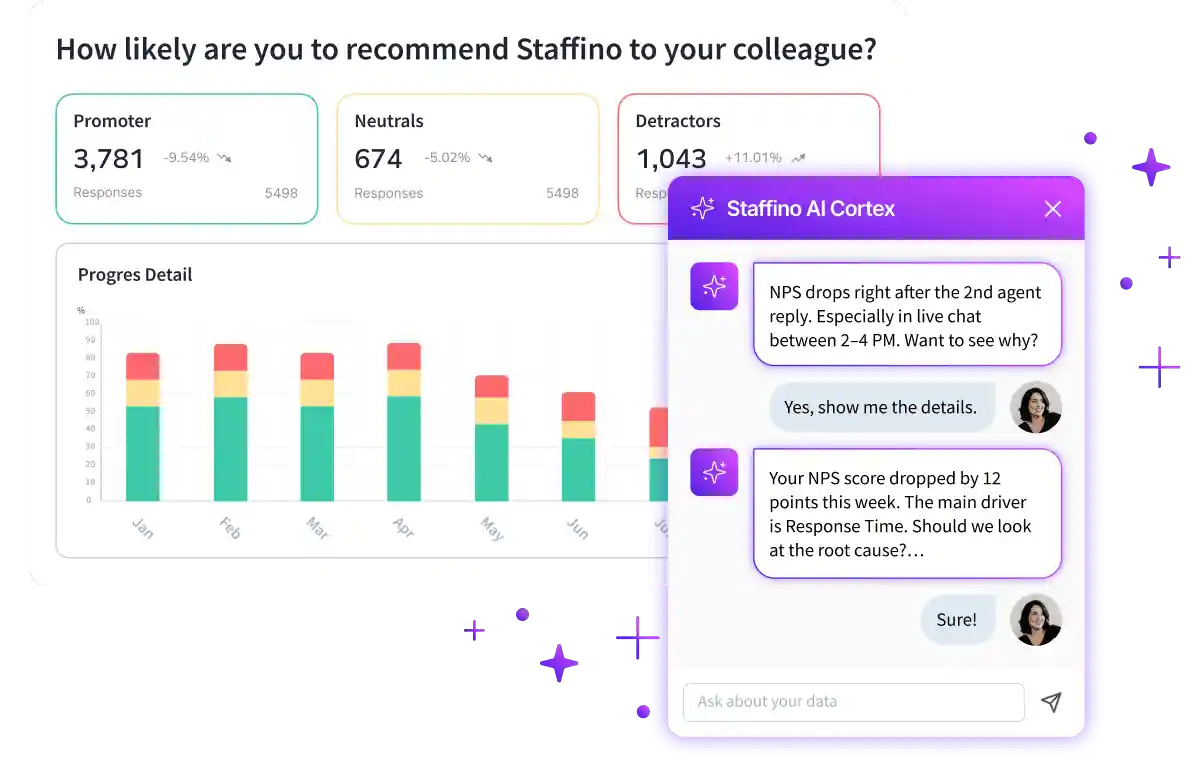
The real gap in today’s AI and CX landscape is not more analytics. It’s embedded advisory intelligence that continuously:
- Frames the business situation
- Connects cause and effect
- Translates data into clear priorities
- Ensures that action actually happens
This is the shift redefining the foundations in AI for CX. Instead of building better reporting tools, leading organisations are beginning to adopt systems that behave more like decision partners. This is where agentic AI in CX enters the picture.
Unlike traditional tools, agentic AI solutions leading in CX automation do not wait for users to explore data. They actively interpret, guide, and follow through. In practice, they function as an always-on consultant, one that operates continuously and at scale.
Introducing Staffino AI Cortex: From Platform to Decision Partner
This shift is precisely what defines Staffino AI Cortex.
Rather than extending a traditional CX AI platform with another analytical layer, AI Cortex represents a fundamental transformation:
From measurement → to decision support → to managed CX change.
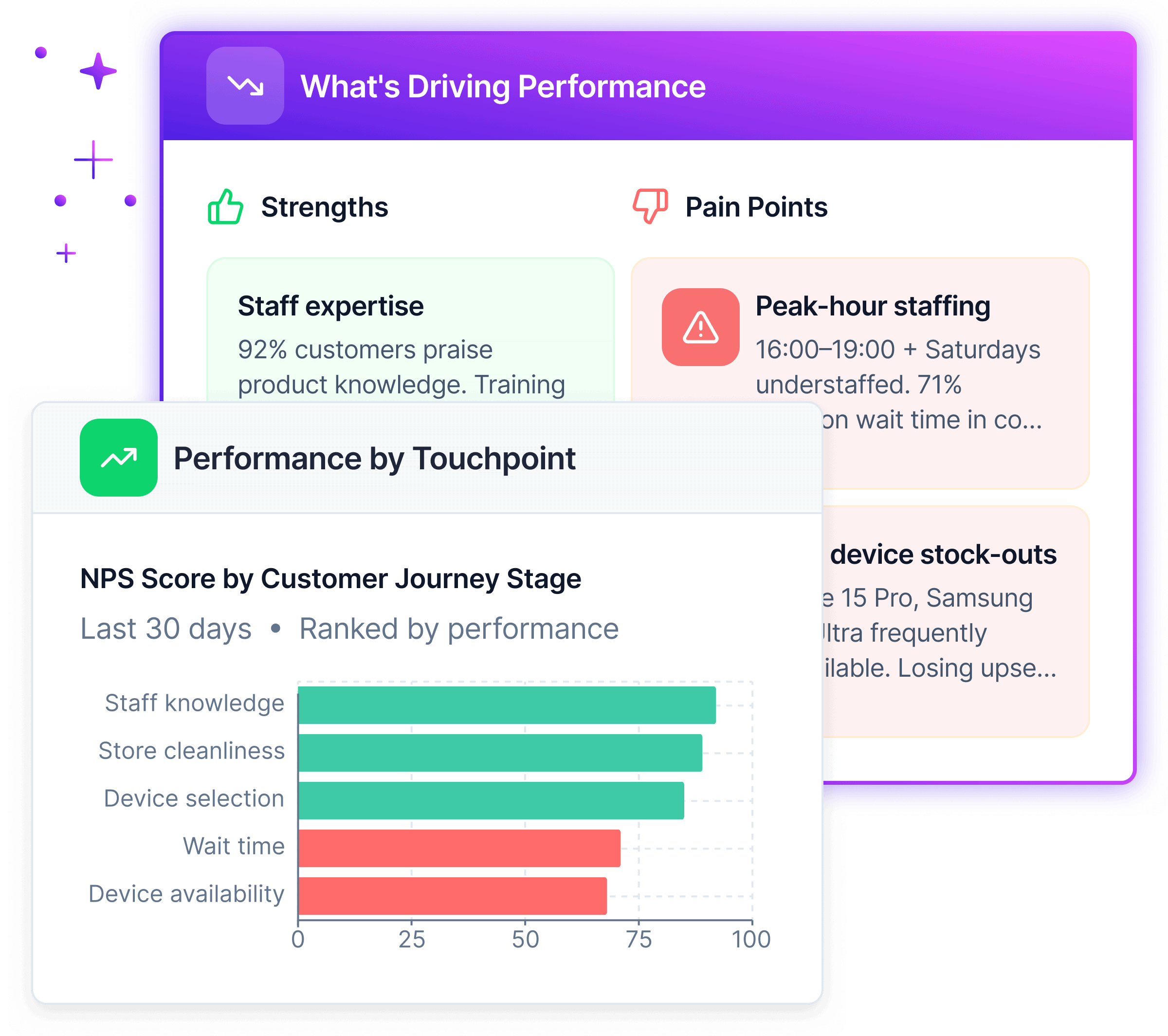
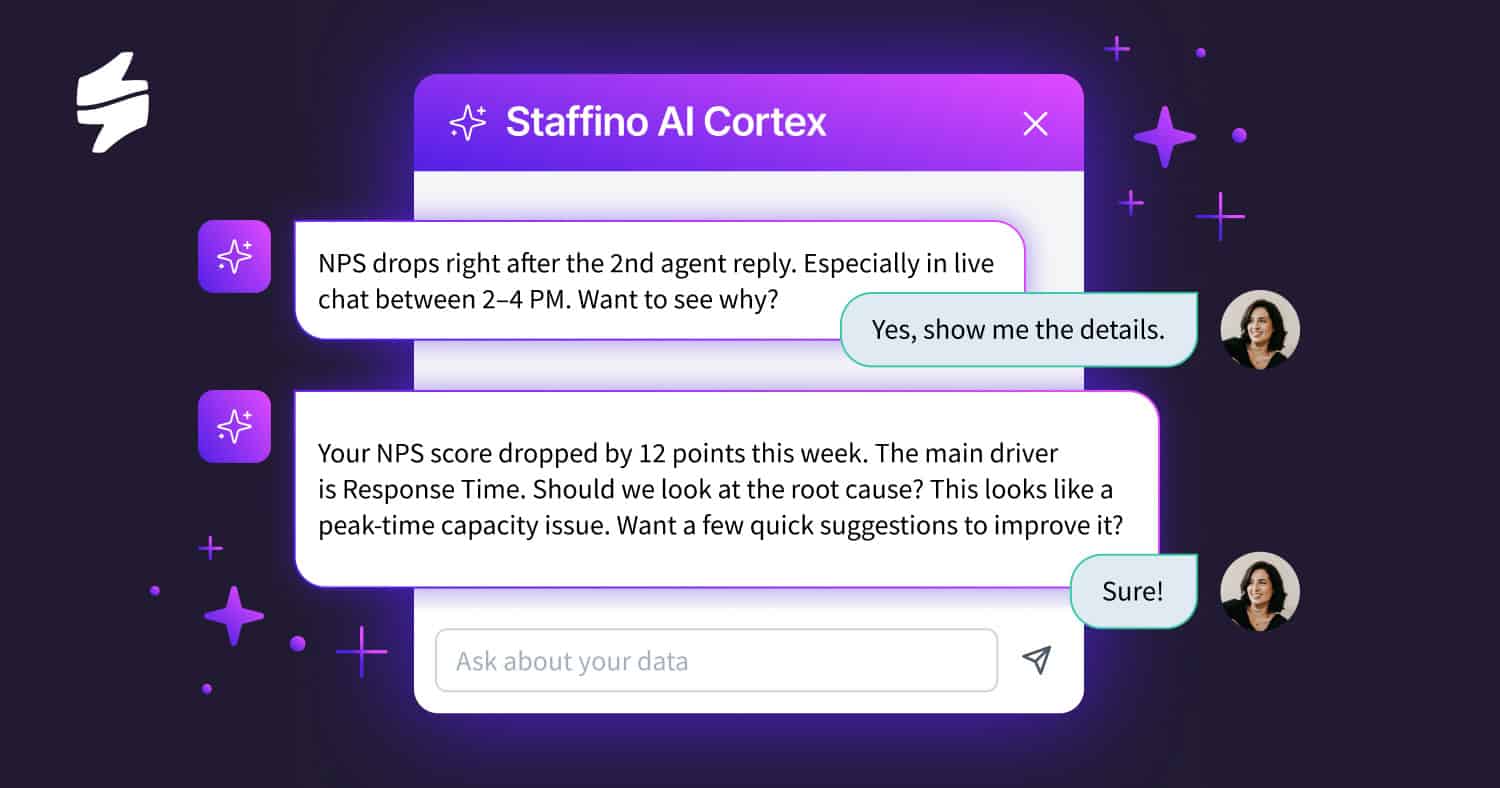
At its core, Staffino AI Cortex is designed as an always-on advisory intelligence layer embedded directly into organisational workflows. It is built for decision-makers, such as CEOs, COOs, CX leaders, and operational managers, who don’t need more dashboards but clearer direction.
The idea is simple, but powerful:
Your data should not just report. It should respond, guide, and act.
How AI Cortex Works: The Push + Pull Intelligence Model
What makes AI in CX truly effective is not just how it analyses data, but how it delivers and drives insight. Staffino AI Cortex is built around a dual model that combines pull-based interaction with push-based intelligence.
1. Pull: Conversational, Contextual Intelligence
Instead of navigating dashboards, leaders interact with the system through a prompt-based interface.
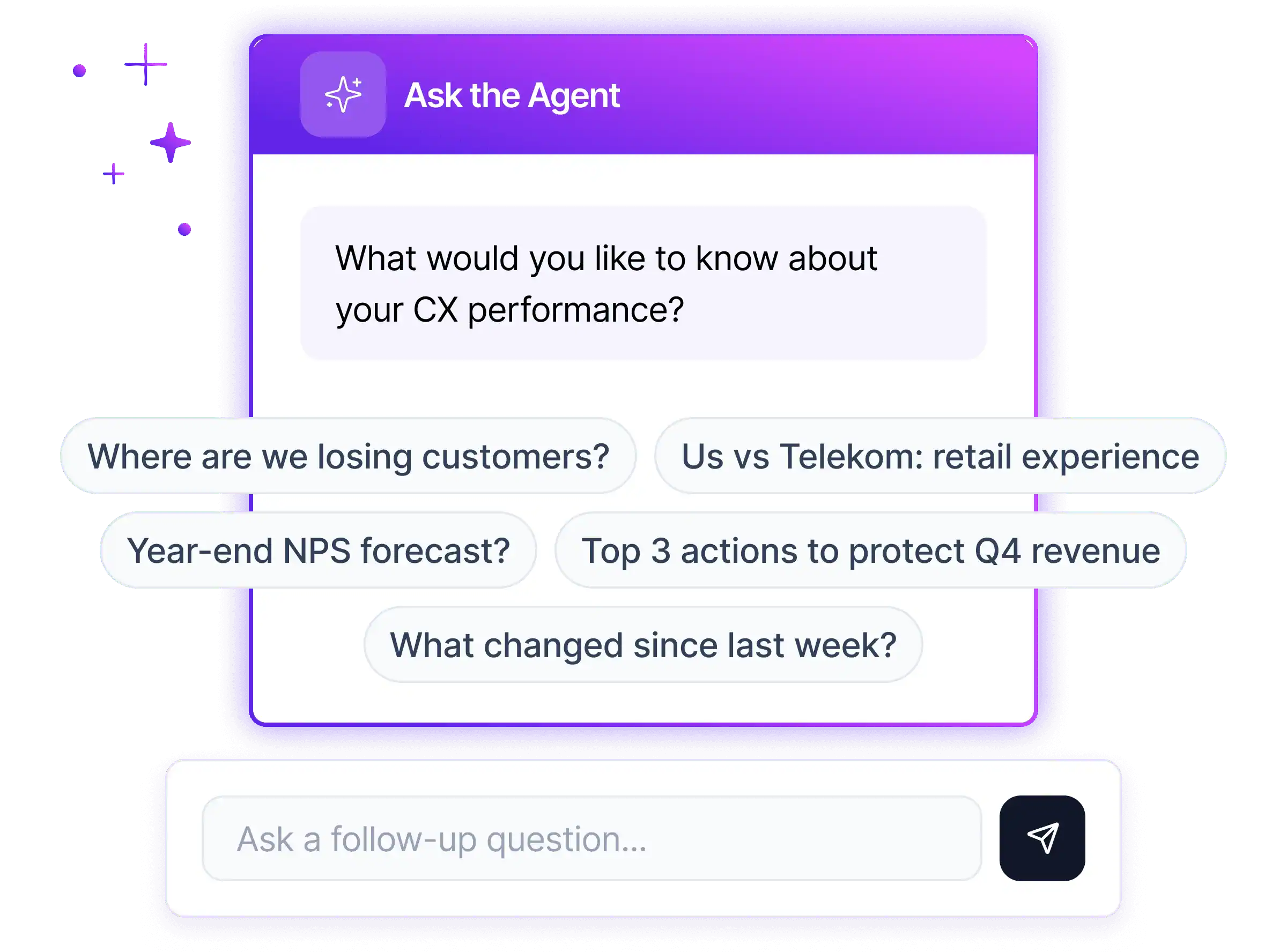
They can ask questions such as:
- “Compare our service performance to our main competitor.”
- “Predict how our customer satisfaction will evolve over the next quarter.”
- “What are the top three actions to reduce onboarding friction?”
The system responds not with raw data, but with structured, consultant-like answers. It:
- Frames the business context
- Benchmarks performance against competitors
- Identifies root causes
- Predicts likely outcomes
- Proposes prioritised actions
This is where generative AI in CX becomes meaningful. It transforms AI for customer insights into something directly usable in decision-making, removing the need for manual interpretation.
Importantly, the system does not rely solely on user input. It actively guides the interaction by suggesting relevant questions based on:
- The user’s role (CEO, CX Director, HR leader, etc.)
- Previous behaviour
- Company-specific context
- Market and competitor dynamics
The result is a system that doesn’t just answer questions, but helps leaders ask better ones.
2. Push: Proactive, Always-On Intelligence
While conversational interaction is powerful, it still depends on users taking the initiative. This is where the second layer becomes critical.
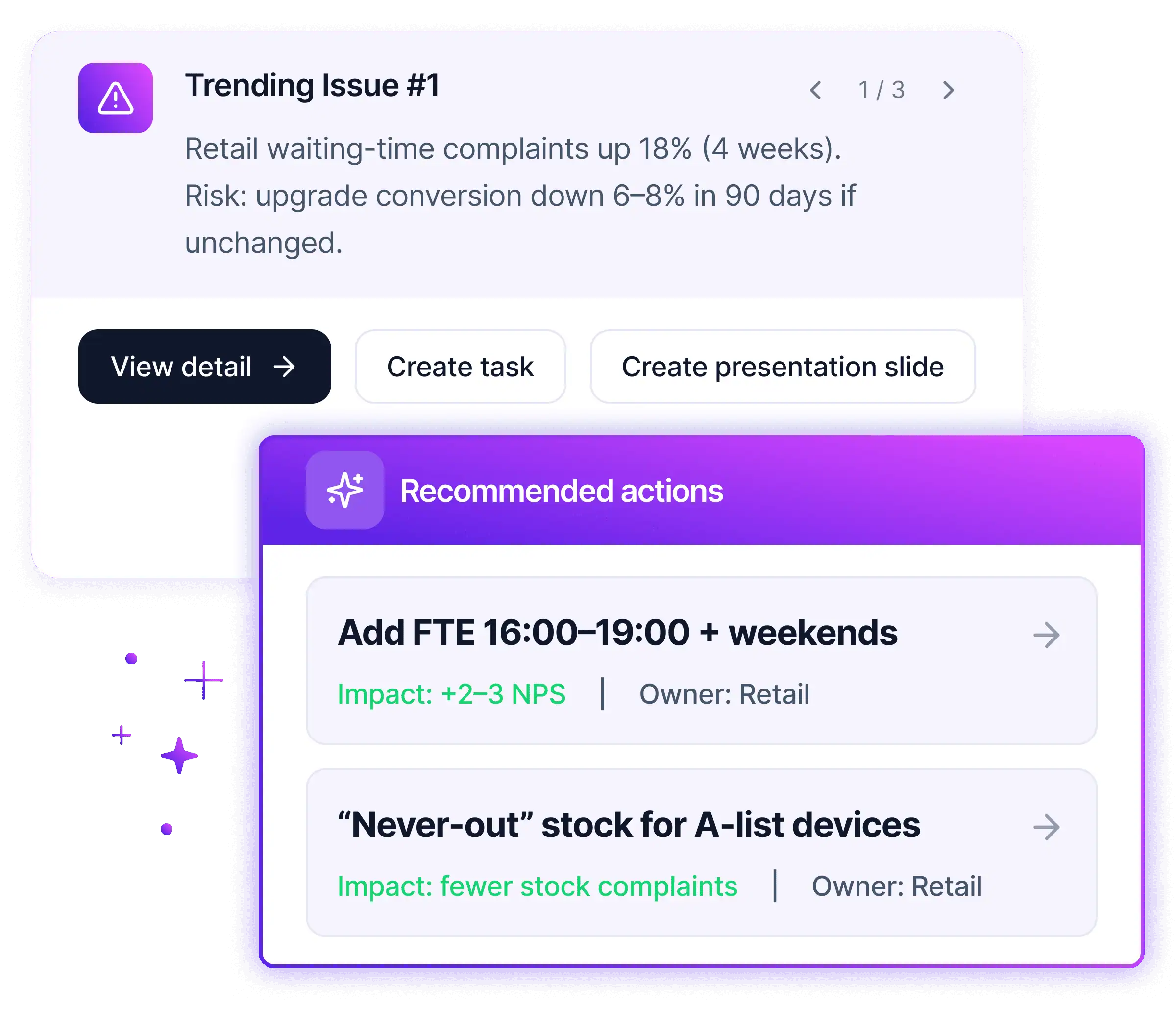
Staffino AI Cortex continuously monitors performance across multiple dimensions, including customer feedback, operational KPIs, competitor signals, and external market factors. When it detects meaningful changes, it proactively reaches out with recommendations.
These are not generic alerts or raw metrics. They are contextualised, advisory messages delivered directly into everyday tools such as Microsoft Teams, Slack, email, or other apps.
For example, instead of reporting a metric change, the system might communicate:
- A detected increase in complaints within a specific journey
- The projected impact on customer satisfaction over the next 3–6 months
- A clear, prioritised recommendation on what to do next
This is where AI for customer engagement extends beyond customers themselves. It becomes a mechanism for engaging internal teams, bringing insight directly into the flow of decision-making.
From Insight to Execution: Closing the Loop
One of the most critical limitations of traditional AI improving customer experience has been the lack of execution.
Even when organisations identify the right priorities, follow-through is often inconsistent. Action plans are created manually, ownership is unclear, and the link between actions and outcomes is rarely validated.
Staffino AI Cortex is designed to close this gap. When the system recommends an action, it does not stop there. It:
- Translates recommendations into concrete tasks
- Assigns ownership
- Proposes deadlines
- Estimates expected impact
These actions are then integrated into existing workflow tools such as Planner, Asana, Jira, or Monday.
From that point forward, the system continues to operate:
- Tracking execution progress
- Sending reminders
- Escalating delays
- Validating whether the expected CX improvement actually occurred
If the outcome does not match expectations, the system adapts its recommendations. This transforms AI in customer experience from a passive analytical layer into an active system of managed change.
Built on Context: Why Generic AI Isn’t Enough
A key differentiator of Staffino AI Cortex is that it is not a generic AI solution. It is built on top of a structured CX ecosystem that integrates multiple layers of data:
- Internal data such as NPS, CSAT, CES, verbatim feedback, journey performance, and operational KPIs
- External signals, including public reviews, competitor ratings, and social sentiment
- Market and regulatory context, from industry trends to consumer protection requirements

By combining these inputs, the system creates a dynamic understanding of each organisation’s environment. This enables it to generate:
- Executive-ready summaries
- Predictive forecasts
- Competitor comparisons
- Actionable roadmaps
- Board-level insights
In this context, customer satisfaction AI is no longer just about analysing feedback. It becomes a way to interpret the entire business landscape.
Beyond Measurement: Connecting CX to Business Outcomes
As organisations adopt more advanced AI and customer experience systems, the role of CX begins to change.
It is no longer treated as a standalone metric or reporting function. Instead, it becomes directly connected to core business outcomes, including revenue, cost efficiency, and customer retention.
By linking customer feedback with operational and employee data, organisations can see how specific issues translate into financial impact. This allows leaders to prioritise actions not just based on satisfaction scores, but on their broader business relevance. This is where AI to improve customer experience becomes a strategic driver rather than a support function.
The Future: From CX Management to CX Governance
The trajectory of AI in CX is moving toward a new model, one where customer experience is continuously governed rather than periodically reviewed.
In this model:
- Risks are identified before they escalate
- Teams are aligned around clearly prioritised actions
- Execution is tracked and enforced
- Outcomes are continuously validated and improved
The system becomes an intelligence layer embedded within the organisation, not something you log into, but something that operates alongside you. This is where CX and AI fully converge.
Final Word: Your Data Should Do More Than Report
Most organisations already have access to vast amounts of customer data. The challenge is no longer collecting it, analysing it, or visualising it.
The challenge is turning it into decisions and ensuring those decisions lead to action.
Without this, even the best foundations in AI for CX will fall short. Insights may exist, but they remain disconnected from execution. And without execution, customer experience does not improve.
This is why the next evolution of AI CX is not about better dashboards. It is about building systems that think, guide, and act. Because in the end, customer experience is not improved by measuring it. It is improved by what you do next.
If you’re rethinking how your organisation uses AI in customer experience, it may be time to move beyond insight and start focusing on impact.
Contact us to see Staffino AI Cortex in action and discover how it can help your team turn customer data into clear decisions, accountable execution, and measurable business results.

Meet the AI That Knows Your Customers
Staffino AI Cortex acts as a generative AI consultant for CX. It understands your feedback, identifies trends, and helps teams make smarter decisions faster.
FAQ
Staffino AI Cortex is an intelligent CX decision engine that goes beyond traditional AI in customer experience tools. It not only analyses data but also recommends actions, assigns tasks, and tracks outcomes to ensure real impact.
It uses generative AI in CX and agentic AI in CX to interpret data, predict trends, and suggest clear next steps, helping teams act before issues escalate.
Pull allows users to ask questions and get contextual answers. Push delivers proactive insights and recommendations without needing to ask.
Traditional dashboards show what happened. AI Cortex explains why, predicts what’s next, and tells you what to do, making AI for customer insights actionable.
AI Cortex turns recommendations into tasks, assigns owners, tracks progress, and validates results, closing the gap between insight and action.
It combines customer feedback, operational KPIs, employee data, and external signals like reviews and benchmarks to provide deeper AI analytical insights.
It’s designed for decision-makers (CX leaders, sales and marketing managers, operations managers, and executives) who need clear direction, not more data.
Modern AI in CX helps organisations move from reactive reporting to proactive decision-making, improving both speed and impact.