

Customer experience does not happen in isolation. Behind every customer interaction is an employee, a process, and an organisation trying to make the experience work.
After exploring the broader state of CX maturity in Romania in Part 1, the organisational foundations behind CX in Part 2, and Voice of Customer and Customer Journey Management in Part 3, the final part of the series turns the focus inward.
How mature is the employee journey in Romanian organisations?
The findings reveal a market with relatively strong HR fundamentals, but a less mature approach to Employee Experience as an integrated journey. At the same time, AI is beginning to reshape parts of EX, although its adoption remains uneven and strongly focused on operational efficiency.
The next step is therefore not simply better HR processes. It is connecting those processes into a measurable, end-to-end employee journey.

Unlock Your Team's Full Potential with Staffino's EX Products
Our EX platform can help you attract and retain top talent, track employee performance, and improve engagement and productivity – so your team can reach their highest potential.
Strong HR Foundations, But a Less Mature Employee Journey
Romanian companies have established many of the fundamental HR practices needed to support employees throughout their time in the organisation.
In 2025, employee performance management and training and development both scored 4.1 out of 5, making them the strongest areas measured. The system for integrating new employees into the team also scored relatively highly, at 3.9. Career planning and succession management scored lower, at 3.4.
These results suggest that many organisations have relatively mature individual HR processes in place. They know how to train employees, manage performance and onboard new people. The challenge is connecting those practices into something bigger.
The weakest area was particularly revealing: KPIs defined for each stage of the Employee Journey scored just 3.0 out of 5.
This creates a clear distinction between managing HR processes and managing the employee experience.
A company can have a strong onboarding process, effective performance management and a solid training programme without necessarily understanding how employees experience the journey as a whole.
From HR Processes to Employee Journey Management
The findings point towards the next stage of maturity: moving from individual HR activities towards mapping, measuring and managing the employee journey end-to-end.
This means understanding the different stages employees go through, from recruitment and onboarding to development, performance, progression and beyond, and looking at how these stages connect.
It also means measuring the experience at each stage rather than relying only on the performance of individual HR processes.
The data suggests that Romanian organisations are not starting from scratch. The foundations are already there. The opportunity now is to connect them.
Employee Feedback Is Becoming More Important
One positive sign is the growing role of employee feedback.

The study shows that Romanian companies are increasingly using systems to gather employee feedback continuously and periodically, with the 2025 score reaching 3.7 out of 5. That matters because an employee journey cannot be managed effectively without understanding how employees experience it.
But collecting feedback is only one part of the equation.
The same principle we saw in the Voice of Customer findings applies internally: gathering feedback does not automatically create insight or improvement.
For Employee Experience to become a more mature discipline, organisations need to connect employee feedback with the different stages of the journey, identify where problems occur, and use those insights to improve processes and policies.
This is also where the relatively low score for Employee Journey KPIs becomes important. Without clear measures for individual stages of the journey, it is harder to understand where the employee experience is working and where it needs attention.
AI in Employee Experience: Practical, but Still Uneven
AI adds another dimension to the employee journey.
The study describes AI adoption within Romanian HR departments as being in a “Pragmatic Exploration” phase, with a notably polarised market.
In 2025, 24% of organisations reported using no AI to improve employee experience, while another 17% used it only to a limited extent.
At the other end of the spectrum, 19% reported using AI quite extensively and 14% very extensively.
This means that while some organisations are already integrating AI into EX, a significant part of the market remains at an early stage. And the areas where AI is being used tell us something important about how organisations currently view the technology.
AI Is Primarily About Productivity
The strongest benefits reported from AI implementation are overwhelmingly operational.
Increased productivity was identified by 60% of organisations using AI in EX. Another 49% reported a reduction in repetitive tasks, while 48% saw benefits in learning and development opportunities. Other benefits, such as improved work-life balance and improved decision-making, were reported much less frequently. Nearly one in five companies report seeing no benefits yet.
The pattern is consistent with the other findings in the study.
Organisations are using AI where its value is relatively straightforward to demonstrate: automating repetitive work, increasing productivity, distributing information and supporting employee development.
This is also reflected in the specific areas where organisations report seeing benefits from AI.
Where Is AI Improving Employee Experience?
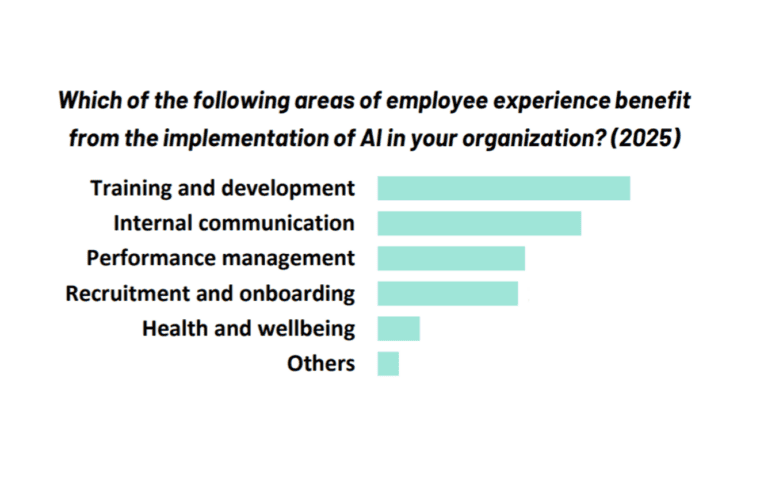
Training and development leads at 55%, followed by internal communication at 45%. The results also show AI being used in performance management, recruitment and onboarding, and health and well-being.
AI is already making its way into activities focused on productivity, communication, learning and workforce capability. But areas involving the more human dimensions of employee experience remain much less affected.
Health and well-being, for example, was identified by only 9% of organisations as an area benefiting from AI.
This suggests that organisations are currently more comfortable using AI as a productivity and capability tool than as a way of addressing the more personal aspects of the employee experience.
The Employee Experience Challenge Is Bigger Than HR
Taken together, the Employee Journey findings point to a broader shift in how organisations need to think about EX.
The challenge is not that Romanian companies lack HR processes. In many areas, the foundations are already relatively strong. Performance management, training and development and onboarding all show solid levels of maturity.
The bigger challenge is integration.
An employee does not experience onboarding, development, performance management and career progression as completely separate processes. They experience one journey through the organisation.
That means organisations need to understand how these moments connect and how employees experience them over time. This is where the gap in Employee Journey KPIs becomes particularly relevant. With a score of 3.0 out of 5, measurement across individual stages remains the weakest area among the practices assessed.
Without this measurement, organisations may know whether a particular HR process is functioning, but have a harder time understanding the employee experience across the entire journey. The next stage of maturity is therefore about moving from HR process management to journey management.

Give Your Employees the Recognition and Motivation They Deserve
Does your team need a little extra motivation? Our platform provides powerful insights into your team’s performance and various recognition tools that help ensure everyone feels appreciated.
From Employee Experience to Customer Experience
There is also a broader CX implication.
The connection between EX and CX has been a recurring theme throughout the study. Customer experience ultimately depends on the people, processes and technology behind it.
A stronger employee journey can support better customer journeys, particularly when employees have the tools, information, training and support they need to deliver the experience an organisation promises.
This makes the development of Employee Experience more than an HR priority. It is part of the wider CX maturity equation. And the findings from the study suggest that Romanian organisations are increasingly building the foundations for this connection. The next challenge is making it systematic.
What Does This Mean for CX Maturity in Romania?
Across the four parts of the CX Maturity Study Romania, a consistent pattern emerges.
Romanian organisations are building stronger CX foundations. They are developing more formal CX strategies, expanding Voice of Customer programmes, improving their approach to customer journeys and adopting AI across different parts of the organisation.
But maturity is not simply about having the right processes or technologies in place. It is about connecting them.
The same principle applies to Employee Experience. The next stage for Romanian organisations is to move from managing individual HR processes towards understanding and continuously improving the end-to-end employee journey.
And as AI becomes more deeply embedded in organisations, success will depend not only on the technology itself, but also on employee readiness, skills and change management. In other words, the future of CX is not only about understanding the customer better.
It is also about creating the conditions for employees to deliver that experience better.
Want the Full CX Maturity Study Romania?
This article concludes our four-part look at the CX Maturity Study Romania, conducted by Staffino in collaboration with Customer Experience Romania.
Across the series, we explored the key dimensions of CX maturity in Romanian organisations, from strategy, culture and governance to Voice of Customer, Customer Journey Management and Employee Experience.
But the articles cover only selected findings. The full research goes much deeper into the data, trends and maturity of Romanian organisations.
Want to see where your organisation or its competitors stand?
Get the complete CX Maturity Study Romania with complete numbers and brand names, and use the findings to benchmark your organisation, identify gaps and build a more informed CX strategy.
You can get the full study in two ways. Either purchase the study directly from the Customer Experience Romania e-shop, or contact the Staffino sales team at [email protected] to request the full report and learn more about how the findings can support your CX strategy.
And if you haven’t read the previous parts yet, explore the full series to see how the different pieces of CX maturity connect—from the foundations of CX management to customer feedback, journey management and finally the employee experience behind it all.

Get a First-Hand Experience Today!
Staffino is the perfect tool for creating engaging surveys, tracking performance, responding to customer feedback, and rewarding top employees. Get started today with our FREE demo!