There is no one-size-fits-all answer to how often businesses should collect customer feedback. Transactional CSAT surveys are most useful shortly after a specific interaction, while relationship-based NPS surveys are typically sent less frequently to measure overall loyalty. The best feedback strategy combines the right timing, channel, and frequency to capture meaningful insights without overwhelming customers.
In this article, we explain how often to send CSAT and NPS surveys, when to ask customers for feedback, when to send NPS survey, and how continuous listening can complement periodic surveys. You’ll also find a practical guide to choosing the right feedback frequency for different touchpoints and keeping survey fatigue under control.

Launch Smarter CX with Staffino Core
Start collecting customer feedback, managing responses in real time, and visualising what drives satisfaction. Build experiences that make people come back. All in one core solution.
What Determines the Right Customer Feedback Frequency?
The ideal customer survey frequency depends on what you want to learn and where the customer is in their journey. Asking someone to rate a recent support interaction is different from asking whether they would recommend your brand.
Before setting a schedule, consider four factors:
- Customer journey: Are you measuring a single interaction, a recent purchase, or the overall relationship?
- Channel: Is feedback collected by email, SMS, in-app prompts, or a website widget?
- Interaction type: Was it a one-off transaction, a recurring service, or a complex issue that took time to resolve?
- Business objective: Do you need to identify service problems quickly, track loyalty over time, or understand friction in a digital journey?
The goal is not to collect as much feedback as possible. It is to collect enough relevant feedback to identify patterns, understand customer needs, and take action.
How Often Should Businesses Send CSAT Surveys?

Customer Satisfaction Score (CSAT) surveys measure how satisfied customers are with a specific product, service, or interaction. Because they focus on a particular experience, they are usually most valuable immediately after the relevant interaction or shortly afterwards.
For example, a business might trigger a short CSAT survey after a customer service call, a completed purchase, a delivery, or a resolved complaint. The timing helps customers evaluate an experience they can still remember clearly.
However, sending a survey after every interaction is not always the right approach. If a customer contacts support several times in one week, repeated requests for feedback can quickly become irritating.
A practical approach is to:
- Trigger CSAT surveys after important or meaningful interactions.
- Set limits on how often the same customer can be surveyed.
- Prioritise interactions that are most relevant to the business objective.
- Keep post-interaction surveys short and easy to complete.
For businesses looking to improve their approach, our guide to customer experience surveys explains how targeted surveys can capture feedback across different customer touchpoints.
What Is a Good CSAT Survey Frequency?
The right CSAT survey frequency depends on interaction volume and customer expectations. A business with frequent customer support contacts may need stricter limits than one that interacts with customers only a few times a year.
As a starting point, consider surveying customers after selected key interactions rather than every minor touchpoint. Then review survey response rates, feedback quality, and customer behaviour to determine whether the frequency is appropriate.
How Often Should You Send NPS Surveys?

Net Promoter Score (NPS) measures how likely customers are to recommend a company, product, or service. Unlike transactional CSAT, relationship NPS aims to capture the customer’s overall perception of the brand.
Because this perception generally changes more slowly than satisfaction with an individual interaction, relationship surveys are usually sent less frequently.
Quarterly or twice-yearly surveys can be a useful starting point, depending on the length of the customer relationship, the pace of change, and how often the business can act on the results. Some organisations may find an annual survey sufficient.
Jan gabauer
Lead Senior XM Auditor & Consultant
The important distinction is between relationship NPS and transactional NPS:
- Relationship NPS measures the overall customer relationship at planned intervals.
- Transactional NPS asks about the likelihood of recommending the business following a particular interaction or experience.
These measures answer different questions. If you already collect transactional feedback frequently, repeatedly asking the same customers for relationship NPS may add little value.
When deciding how often to send NPS surveys, establish a consistent schedule, avoid overlapping requests, and make sure the results can be compared meaningfully over time.
When Is the Best Time to Send an NPS Survey?
The best time depends on what you want to measure.
→ For relationship NPS, send the survey at a consistent point in the customer relationship or at regular intervals. For new customers, allow enough time for them to experience the product or service before asking them to assess the relationship.
→ For transactional NPS, send the survey soon after the relevant experience, once the customer has had enough time to form an opinion. For example, feedback after onboarding may be more useful once the customer has completed the initial setup and used the service.
Avoid sending an NPS survey immediately after a frustrating interaction if the aim is to measure overall brand loyalty. In that situation, a short CSAT survey may provide more relevant information about the specific experience. Ultimately, when to send NPS survey should be determined by the question you need to answer, not simply by a convenient date in the calendar.
What Is the Difference Between Continuous and Periodic Customer Feedback?
Periodic surveys collect feedback at planned intervals or after defined events. Continuous customer feedback captures insights throughout the customer journey, using channels such as website feedback widgets, in-app prompts, and ongoing feedback collection.
Both approaches have a role in a well-designed CX programme.
Feedback type | Suggested timing | Best suited for |
Transactional feedback | Shortly after a key interaction | Measuring satisfaction with support, purchases, delivery, or complaint resolution |
Relationship surveys | Quarterly, twice yearly, or annually, depending on the business | Tracking overall satisfaction and loyalty over time |
Website feedback | When relevant behaviour or a defined page interaction occurs | Identifying friction in forms, checkout, navigation, or content |
Always-on feedback | Available continuously, with exposure limits | Capturing unsolicited comments and emerging issues throughout the journey |
These are starting points, not universal rules. Businesses should adjust them to customer behaviour, interaction volume, and the decisions the feedback needs to inform.
Periodic surveys make it easier to track changes against a consistent schedule. Continuous customer feedback, meanwhile, can help teams notice emerging issues between survey cycles instead of waiting until the next quarterly or annual measurement.
For example, a quarterly relationship survey might reveal that customers are becoming less satisfied with an online service. Website feedback can help identify the specific page or step where customers experience difficulty.
How Can Businesses Collect Real-Time Customer Feedback Without Causing Survey Fatigue?
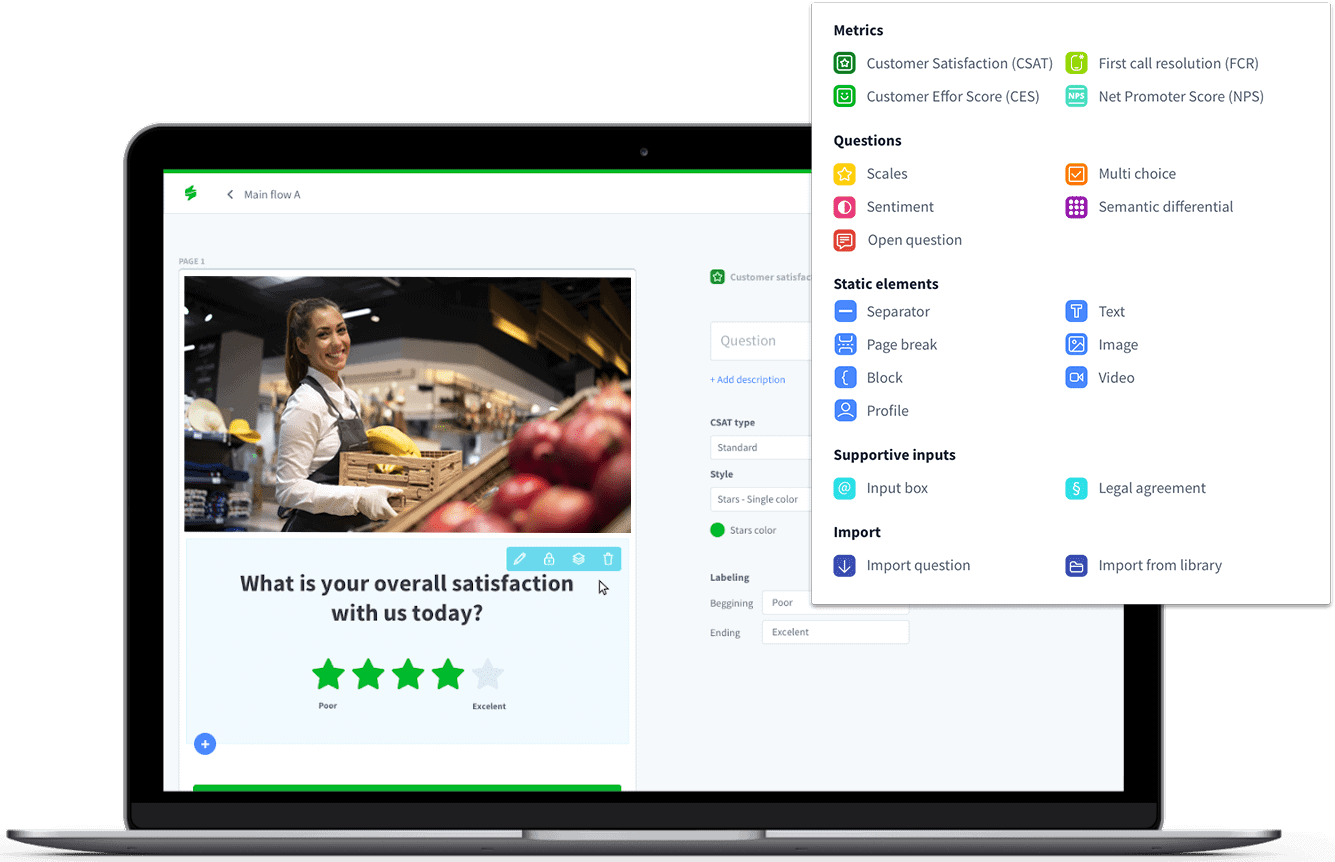
Real-time feedback is especially useful when the experience is happening now or when a problem needs attention quickly. But continuous listening should not mean constantly interrupting customers with surveys.
To collect real-time customer feedback without creating survey fatigue, businesses should focus on relevance, timing, and frequency controls.
- Trigger feedback at meaningful moments. Ask after a completed purchase, a resolved support request, or a significant website interaction, not whenever a customer clicks something.
- Set frequency limits. Prevent customers from receiving repeated survey invitations within a short period. Website feedback tools can also limit how often a widget appears to the same visitor.
- Keep surveys focused. Ask only questions that support a clear objective. A short question about a specific experience is often more appropriate than a lengthy questionnaire.
- Coordinate feedback across channels. Customers may interact with a business through its website, email, app, and support team. If each channel sends surveys independently, the combined experience can become excessive. Use shared rules where possible to prevent overlapping requests.
- Close the feedback loop. Collecting feedback is only the first step. Teams should review responses, follow up where appropriate, and communicate what has changed. This is the essence of closed-loop feedback: ensuring that customer input leads to a response or improvement rather than disappearing into a report.
Get Actionable Insights with Closed Loop Feedback Management
With Staffino, you'll never leave a customer unhappy again! Streamline the process of collecting and responding to feedback, identify areas of improvement, and make sure that customer issues are addressed quickly and effectively.
For digital journeys, Staffino’s Website Feedback Surveys let businesses collect feedback directly on their websites, target specific visitors, and configure how often the feedback widget appears. This makes it possible to capture insights in context while controlling interruptions.
How Can You Tell If You’re Asking for Feedback Too Often?
Survey fatigue does not always appear as an explicit complaint. It may show up as declining response rates, more incomplete surveys, or customers repeatedly ignoring requests.
Watch for changes such as:
- Falling response rates despite stable distribution.
- More partially completed surveys.
- Repeated feedback from the same small group of respondents.
- Complaints about being asked for feedback too often.
- Little new insight from recurring surveys.
These signals do not automatically prove survey fatigue. Survey response rates can also change because of survey length, channel, relevance, or timing. Review these factors together before changing the frequency.
A useful rule is to survey less when you cannot act on the results, and listen more closely when a meaningful customer interaction needs attention. If teams are still analysing the last round of feedback, sending another broad survey may create more data without producing better decisions.
Make Customer Feedback More Timely and Actionable
The right customer feedback strategy is not about choosing between frequent surveys and occasional research. It is about combining both in a way that reflects the customer journey.
Use transactional CSAT to understand specific experiences, relationship NPS to monitor loyalty over time, and continuous feedback to identify issues as they emerge. Apply frequency limits across channels, keep surveys relevant, and make sure the organisation has a process for acting on what customers share.
Staffino helps businesses collect and manage customer feedback across key touchpoints, monitor results, and turn customer insights into practical improvements. With targeted surveys and real-time feedback collection, teams can listen at the moments that matter without relying on a constant stream of survey invitations.
Want to make customer feedback more actionable? Explore Staffino’s customer experience surveys and see how a more targeted approach can support better CX decisions.
Get a First-Hand Experience Today!
Staffino is the perfect tool for creating engaging surveys, tracking performance, responding to customer feedback, and rewarding top employees. Get started today with our FREE demo!
FAQ
It depends on the objective and touchpoint. Transactional feedback is usually collected after important interactions, while relationship surveys may be sent quarterly, twice yearly, or annually. Always-on feedback can complement both, provided customers are not repeatedly interrupted.
For relationship NPS, quarterly or twice-yearly surveys are a reasonable starting point for many businesses, although annual measurement may suit some customer relationships. Transactional NPS should be tied to relevant experiences and coordinated with other survey requests.
Send a CSAT survey shortly after the interaction you want to measure, while the experience is still fresh. For complex interactions, wait until the issue has been resolved or the customer has had time to experience the outcome.
Limit how often each customer is contacted, keep surveys short, prioritise meaningful interactions, coordinate requests across channels, and use passive or always-available feedback options where appropriate.
Periodic feedback is collected at scheduled intervals or after defined interactions. Continuous feedback is gathered throughout the customer journey, helping businesses identify emerging issues between planned survey cycles.
Closed-loop feedback ensures customer input is reviewed and acted upon. It may involve following up with an individual customer, resolving a problem, or using recurring feedback patterns to improve a process.