

Customer expectations continue to rise, while technologies like AI are transforming how organisations listen to customers, understand their needs, and deliver better experiences. But how prepared are Romanian companies for this shift? How mature are their customer experience strategies, and where are the biggest opportunities for improvement?
To answer these questions, Customer Experience Romania, in partnership with Staffino, conducted the CX Maturity Study Romania over the 2023–2025 period, providing a comprehensive assessment of how organisations approach customer experience today.
The study provides a unique perspective on the evolution of CX maturity across the Romanian market. By tracking progress over time, it highlights not only where organisations stand today, but also how their priorities, capabilities, and investments are changing as customer expectations continue to evolve.
This article provides an executive summary of the study’s key findings, highlighting the most important trends shaping customer experience in Romania today. Rather than focusing on individual metrics, we’ll explore the broader picture—where organisations are making progress, where challenges remain, and what these findings reveal about the current state of CX maturity.
Over the coming weeks, we’ll dive deeper into each area of the research in a dedicated series of articles, covering:
- CX Strategy, Governance, Culture, Processes & Technology
- Voice of Customer & Customer Journey Management
- Employee Journey and Experience

Experience Management Made Smart
Boost your business performance with Staffino – the ultimate platform to deliver unique experiences for your customers and employees.
About the CX Maturity Study Romania
The CX Maturity Study Romania provides a comprehensive picture of customer experience maturity across Romanian organisations. As the first cross-industry benchmark of its kind in Romania, it combines insights into organisational capabilities with customer perceptions to offer a holistic view of the country’s customer experience landscape.
The FULL REPORT brings together three years of CX maturity research, developed in partnership with Staffino, and the Customer Centricity Index, developed with Ipsos. This combined approach makes it possible to track how organisational maturity evolves over time alongside changing customer expectations, revealing the strengths, challenges, and emerging trends shaping customer experience across industries.

The report is a strategic guide for business leaders and CX professionals seeking to build more customer-centric organisations, turn customer insights into competitive advantage, and stay ahead in an increasingly demanding market.
The CX maturity assessment focuses on three key dimensions:
- CX Strategy & Governance – how organisations define, implement, and manage their customer experience strategy.
- Voice of Customer & Customer Journey Management – how companies collect customer feedback, transform insights into action, and optimise customer journeys.
- The Connection Between CX, EX & AI – how customer experience, employee experience, and artificial intelligence are beginning to work together to improve business performance.
Methodology
The CX Maturity Study gathered insights from almost 100 Romanian organisations across 18 industries, making it one of the broadest snapshots of customer experience maturity in Romania to date. The research spans sectors including banking and financial services, retail, pharmaceuticals, telecommunications, software and IT, utilities, manufacturing, automotive, healthcare, and many others, providing a comprehensive view of the Romanian CX landscape.
Who Participated in the Study?
The research reflects the perspectives of organisations with diverse business models, sizes, and ownership structures, ensuring a well-rounded picture of CX maturity across the market.
More than one-third of participating companies employ over 2,000 people, while the study also includes small and medium-sized businesses, creating a balanced mix of organisations at different stages of growth. Respondents represent companies serving B2C, B2B, and hybrid B2B/B2C markets, allowing the findings to capture customer experience practices across different business environments.

The participant pool also includes organisations of varying ownership structures, with 57% operating as primarily foreign-owned companies, 27% as Romanian-owned businesses, and 13% with mixed ownership.
Importantly, the survey gathered responses from professionals directly involved in shaping customer experience strategies. Nearly 60% of respondents hold CX leadership, senior management, or executive positions, including CX managers, directors, C-level executives, and CEOs, while the remaining participants are experienced middle managers and specialists responsible for implementing customer experience initiatives within their organisations.
Executive Summary & Key Findings
1. Romanian CX Is Moving From Strategy to Execution
Romanian companies are entering a new stage of customer experience maturity. The focus is gradually shifting from defining CX strategies to making them work in practice.
From Strategy Design to Operational Delivery
In previous years, developing the CX strategy was one of the main priorities for customer experience teams. In 2025, attention moved towards execution: distributing customer feedback, improving products and services, and redesigning internal processes.
This shift is also visible at leadership level. More than 53% of CX teams now report directly to the C-suite, indicating that customer experience is increasingly seen as a strategic business function rather than only a support activity.
At the same time, CX teams are becoming more professionalised.
“Organisations increasingly rely on specialists with dedicated CX experience instead of assigning the responsibility to employees alongside unrelated operational roles.”
MARTINA BABICOVA
Employee Experience Specialist, Staffino
The Technology Paradox
Romanian companies have become better at collecting customer feedback, but they are not always equally effective at interpreting it.
44% still use no AI to analyse customer feedback. This creates a gap between hearing the customer and understanding what requires action.
A similar issue appears in customer journey management. Many organisations use modern methodologies such as customer journey mapping, yet more than half still manage complex journeys in Excel. As a result, journey maps can remain static documents rather than tools connected to real-time data, ownership, and performance.

Let AI Handle the Heavy Lifting in CX
With Staffino’s AI, you can respond with empathy at scale, understand customer feedback faster, boost upsell, and make smarter decisions with almost no effort.
AI Must Balance Efficiency and Empathy
AI adoption in Romanian CX is currently driven mainly by efficiency and productivity. Organisations are using it to support areas such as data processing, employee training, and internal communication.

However, companies remain cautious about the human impact of automation. 45% fear losing the human connection, while 62% are concerned that customers may not accept AI-supported interactions.
The next step will therefore not be to automate every possible touchpoint. It will be to identify where AI improves speed and consistency, and where employee empathy, judgement, and personal interaction remain essential.
2. The Biggest CX Challenges in the Past Years and Priorities in 2026
The findings show that the main obstacles to CX maturity are not only technological. CX measurement, internal alignment, skills, and implementation remain equally important.
Proving CX Value Remains the Main Barrier
The most frequently reported challenge in 2025 was calculating the financial return of CX initiatives, mentioned by 53% of organisations.

Without a clear connection between customer experience and outcomes such as retention, revenue, efficiency, or cost reduction, CX teams may struggle to secure investment and gain wider internal support.
Other barriers include limited employee capacity, insufficient CX skills, fragmented systems, and difficulties encouraging teams to view their work from the customer’s perspective.
Together, these findings suggest that CX maturity depends on the whole organisation, not only on the team formally responsible for customer experience.
2026 Will Be About Implementation
The priorities for 2026 reflect a more operational and ROI-driven agenda.
Companies plan to focus on improving customer experience metrics, digitising internal processes, supporting digital customer interactions, and implementing projects already defined in their CX strategies.
There is also growing interest in linking CX indicators with operational KPIs, training customer-facing employees, and developing internal communities of CX ambassadors.
The direction is clear: Romanian organisations are moving from planning customer experience towards embedding it into everyday business operations.
3. Delivering the Promise Is Only the Starting Point
We also examined how companies assess the experience they currently deliver.
Most Companies Believe They Meet Expectations
“57% of companies consider the experience to be as promised, 22% better than promised, and 21% below expectations.
JAN GABAUER
Lead Senior XM Auditor & Consultant, Staffino
”
This suggests that most organisations feel they are meeting their basic customer promise. However, only a relatively small share believe they consistently exceed it.
The Harder Challenge Is Consistency
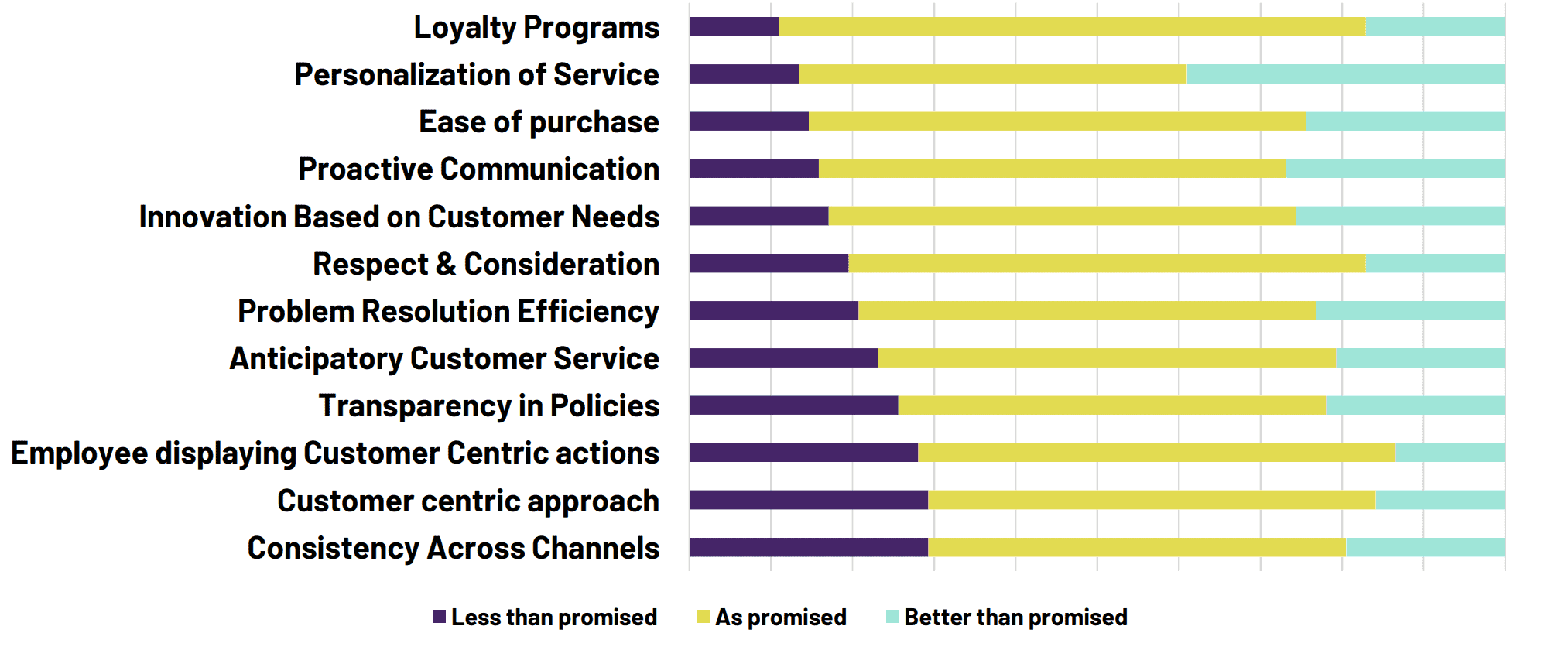
Companies tend to assess themselves most positively in areas such as customer loyalty programmes, personalisation, and ease of purchase.
At the same time, they recognise greater room for improvement in proactive communication, consistency across channels, and embedding customer centricity throughout the organisation.
This highlights an important difference between individual CX initiatives and overall CX maturity. A company may offer personalisation or a loyalty programme, but still struggle to deliver one connected and consistent experience across the full customer journey.
The next stage of maturity will therefore depend less on adding isolated CX activities and more on connecting strategy, technology, employees, and customer insight into coordinated action.
Want to Explore the Findings in More Detail?
This executive summary offers only a first look at the state of customer experience in Romania. In the next three parts of the series, we will explore the findings more closely, focusing on:
- the foundations of CX maturity, including strategy, governance, culture, processes, and technology;
- how organisations collect and use customer feedback, manage journeys, measure performance, and close the loop;
- the employee journey and how employee experience and CX affect each other in Romanian organisations.
Subscribe to the Staffino newsletter to be notified as soon as each new article is published.
Contact our sales team at [email protected] to receive the full CX Maturity Study Romania, or purchase it directly from the Customer Experience Romania online store.