


Customer experience in Romania is moving from strategy to execution. As we explored in part 1 of our CX Maturity Study Romania series, organisations are increasingly treating CX as a strategic business function, while also recognising that meeting customer expectations is only the starting point. The next challenge is turning CX ambitions into consistent, organisation-wide action.
In part 2, we take a closer look at what sits behind a mature customer experience: CX strategy, organisational culture, governance, processes, and technology. How many Romanian companies have a formal CX strategy? Who is responsible for driving it? How much influence do CX teams have on business decisions? And are technology and AI helping organisations create more connected customer experiences?
The findings show clear progress across the Romanian market. CX teams are becoming more specialised, customer centricity is increasingly reflected in organisational values, and companies are investing in automation and AI. But they also reveal an important gap: having the right CX structures in place does not automatically mean that customer experience has become embedded across the organisation.
In this article, we explore where Romanian organisations stand today, and what they need to do to move from having CX capabilities to truly embedding CX into the way the business operates.

Experience Management Made Smart
Boost your business performance with Staffino – the ultimate platform to deliver unique experiences for your customers and employees.
CX Strategy Is Becoming More Embedded in the Business
The first sign of progress is strategic. In 2025, 68% of surveyed organisations reported having a formal CX or customer strategy, while another 22% planned to develop one in the following year.
The maturity of these strategies is also improving. Compared with 2023 and 2024, organisations reported stronger alignment between CX strategy and the broader business strategy, greater communication of CX objectives, more consistent monitoring, and stronger interdepartmental collaboration.
One of the biggest improvements can be seen in the connection between CX and company values. The score for “Customer centricity is reflected in the company’s values” reached 4.4 out of 5 in 2025, up from 4.2 in the previous two years.
This suggests that customer centricity is becoming more than a CX department’s responsibility. It is increasingly being positioned as part of how organisations define themselves.

However, one area continues to lag behind: budgeting. The lowest score in the strategic assessment was recorded for allocating a budget specifically to customer experience activities. In other words, organisations increasingly say CX matters. The next challenge is making sure their investment decisions reflect that priority.
CX Leadership Is Becoming More Professionalised
The research also points to a significant shift in who owns customer experience.
In 2025, 68% of organisations reported having a dedicated CX team or department, while another 12% planned to establish one in the following year.

The composition of these teams is changing, too. The share of CX professionals with a dedicated Customer Experience background has grown by 9.4% since 2023, suggesting that CX is becoming an increasingly specialised professional discipline within Romanian organisations.
At the same time, the share of CX professionals coming from Customer Relations or Operations backgrounds has decreased by 18.9% since 2023. This shift further suggests that CX is increasingly developing into a distinct professional discipline rather than being treated primarily as an extension of customer service.
The reporting structure reinforces this trend. More than half of CX teams report directly to the C-suite, combining teams reporting to C-level management and CEOs. That matters because CX maturity depends not only on having people responsible for customer experience, but on giving those people enough influence to change how the organisation operates.
“True CX maturity begins when the voice of the customer is systematically transformed into business decisions; this study serves as a vital reality check, empowering companies to distinguish operational hygiene from true differentiation by building strategies on data, not just intuition.”
Stefan Dumitru
Regional Manager, Staffino
Customer-Centric Culture Is Stronger Than CX Governance
The research reveals an interesting gap between what organisations say about customer-centricity and how much influence CX teams actually have.
Companies score highly when asked whether customer focus is a priority for management. In 2025, this received a score of 4.3 out of 5, unchanged from 2023 and 2024. The overall assessment of company culture as customer-centric also rose to 4.0, compared with 3.9 in the previous two years. Management is also increasingly using customer feedback in decision-making in 2025.
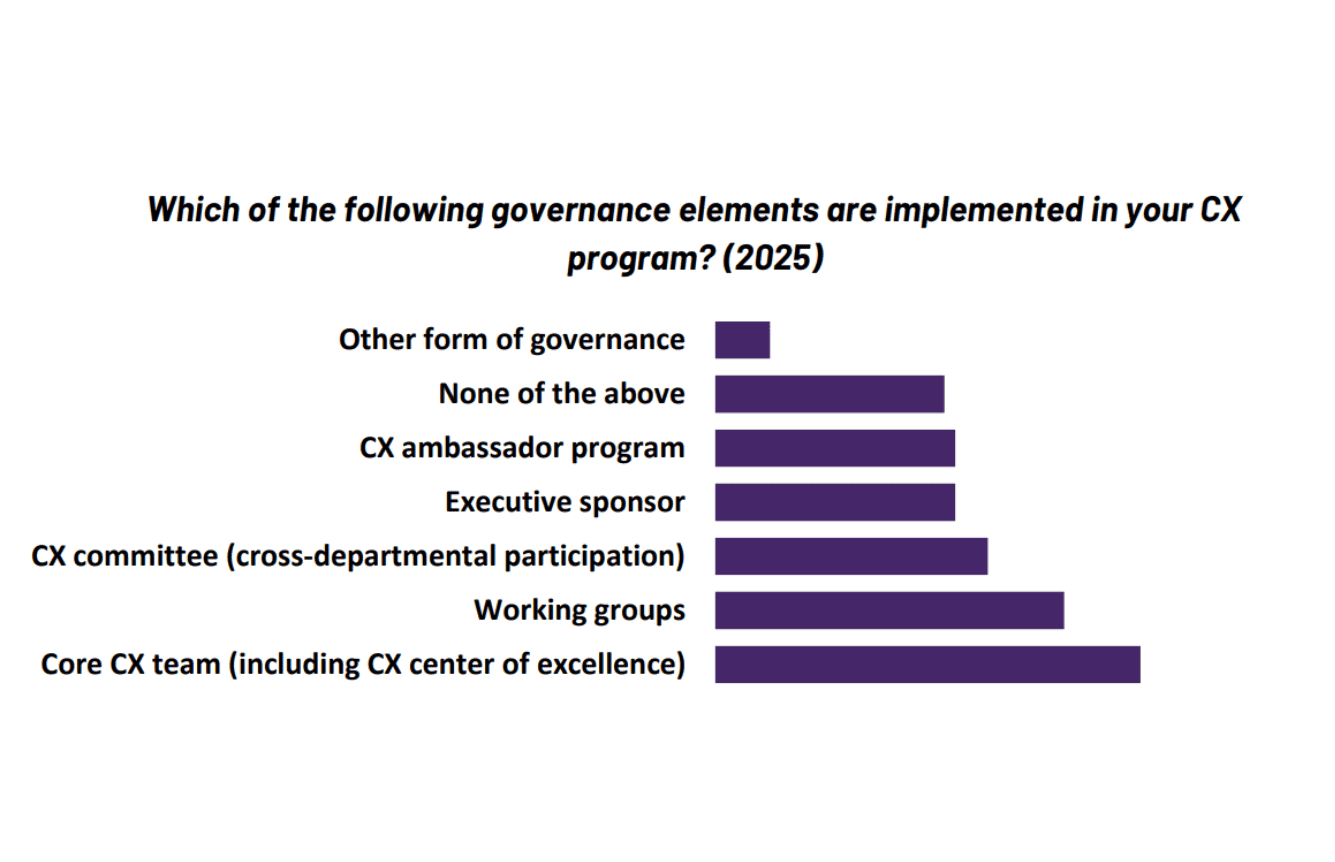
However, as you can see above, formal governance mechanisms are still developing. Only 45% of organisations have established a core CX team or centre of excellence, with even fewer relying on working groups or cross-departmental CX committees. Meanwhile, a substantial share report having none of these governance structures in place.
More importantly, the CX department’s influence over decisions regarding the prioritisation and implementation of projects remains relatively modest, despite improving from previous years.
This creates a clear distinction between customer-centric intent and organisational power. A company can genuinely value customer-centricity while still lacking the governance structures that allow customer insight to influence priorities, budgets, and operational decisions.
From CX Team to CX Responsibility
The role of CX teams is changing as these structures mature.
In 2025, CX teams reported a 44.4% increase in their contribution to improving internal processes compared with 2023. Their role in improving products and services also increased greatly.

At the same time, the role of the CX team in developing the CX strategy remains strong, while its function is gradually expanding into practical business improvement. This signals an important shift: CX is moving from strategy design towards operational execution.
Customer-centricity is increasingly becoming a shared responsibility rather than something that sits exclusively with a CX team. As more departments become involved in improving products, services, and internal processes, the CX function can move away from being the organisation’s sole “customer advocate” and towards enabling the systematic use of customer insight across the business.
Processes and Technology Are Catching Up
The study also shows a clear step forward in process and technology maturity.
Romanian organisations report a stronger ability to adapt their processes and technology to changing customer expectations, with the corresponding score reaching 4.1 out of 5 in 2025.
Several other operational foundations are becoming more established, in the following order:
- the role of automation in improving customer experience processes
- measuring employee performance through process KPIs
- having an SLA system between the organisation and the customer
- having a complete, real-time view of customer interactions across channels
The last one is particularly telling. While organisations are becoming more capable of automating and formalising customer experience processes, creating a truly connected view of the customer remains more difficult.
This is an important distinction. Technology can make individual processes faster without necessarily making the overall customer experience more connected.
AI Is Growing, but Efficiency Comes First
AI is now part of the customer experience landscape, but Romanian companies are still approaching it primarily as an efficiency tool.
In 2025, 46% of organisations identified increased efficiency as the greatest benefit of implementing AI in CX, well ahead of improving customer satisfaction, 24/7 availability, cost reduction, and advanced customisation.
The current use cases reflect this pragmatic approach. Chatbots are used by more than half of organisations, followed by virtual assistants in second place and sentiment analysis in third.
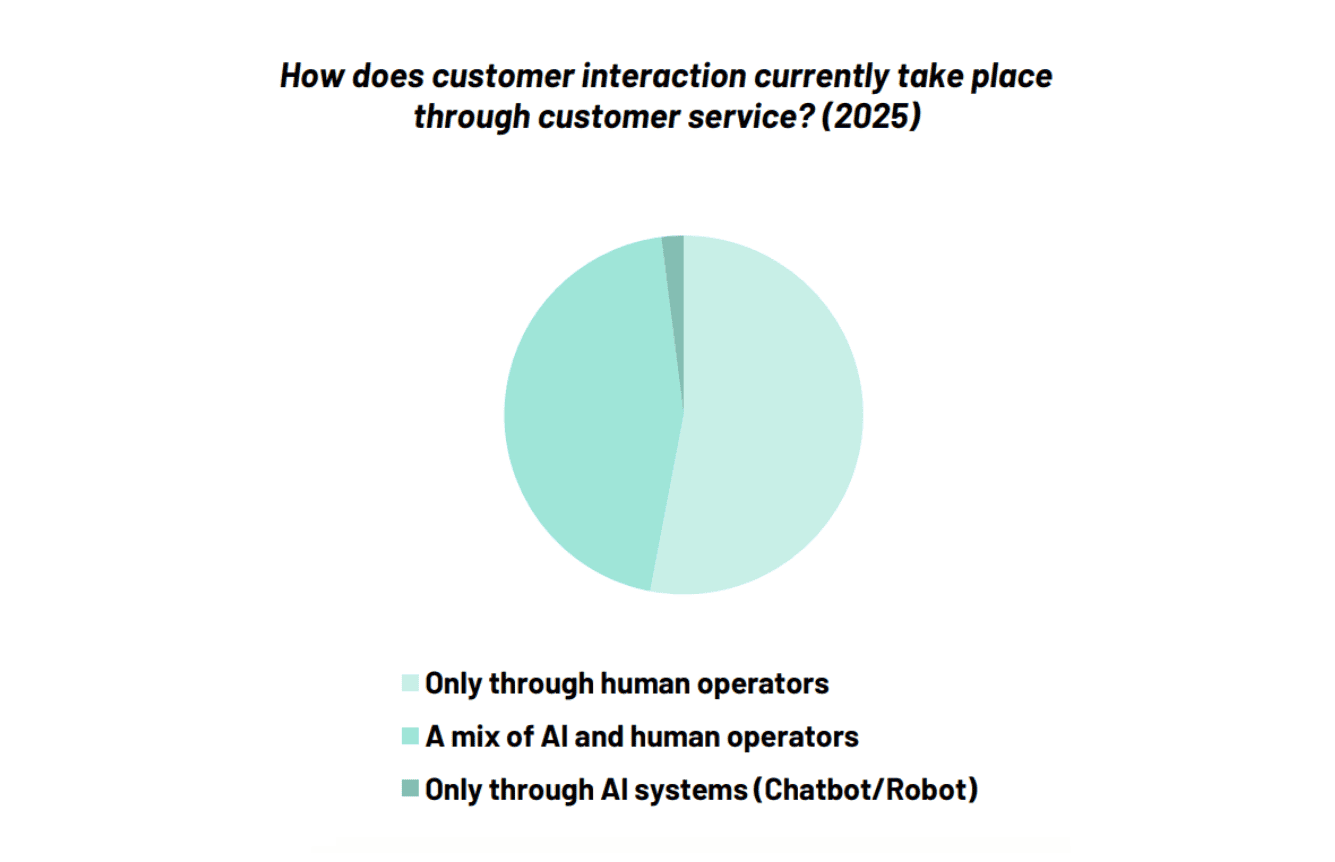
As you can see from the pie chart above, customer service is also becoming increasingly hybrid. Although human-only support is still the dominant model, hybrid AI–human teams have become nearly as common, whereas fully AI-driven customer service remains the exception.
And when organisations measure the success of AI, the focus is again largely operational. Reducing response time leads at 52%, followed by increased customer satisfaction, reduced operating costs, increased conversion, and increased customer loyalty.
This suggests that AI is already helping organisations improve speed and capacity, but its contribution to deeper customer outcomes is still developing.

Let AI Handle the Heavy Lifting in CX
With Staffino’s AI, you can respond with empathy at scale, understand customer feedback faster, boost upsell, and make smarter decisions with almost no effort.
The AI Paradox: Efficiency Without Losing Humanity
Perhaps the most interesting finding is that Romanian organisations are not blindly embracing AI. They see its potential, but they also see the risks. The biggest anticipated challenges include integration with existing systems and customer acceptance of AI-based interactions.
And the biggest fear? Losing human connection with customers, cited by the majority of respondents.
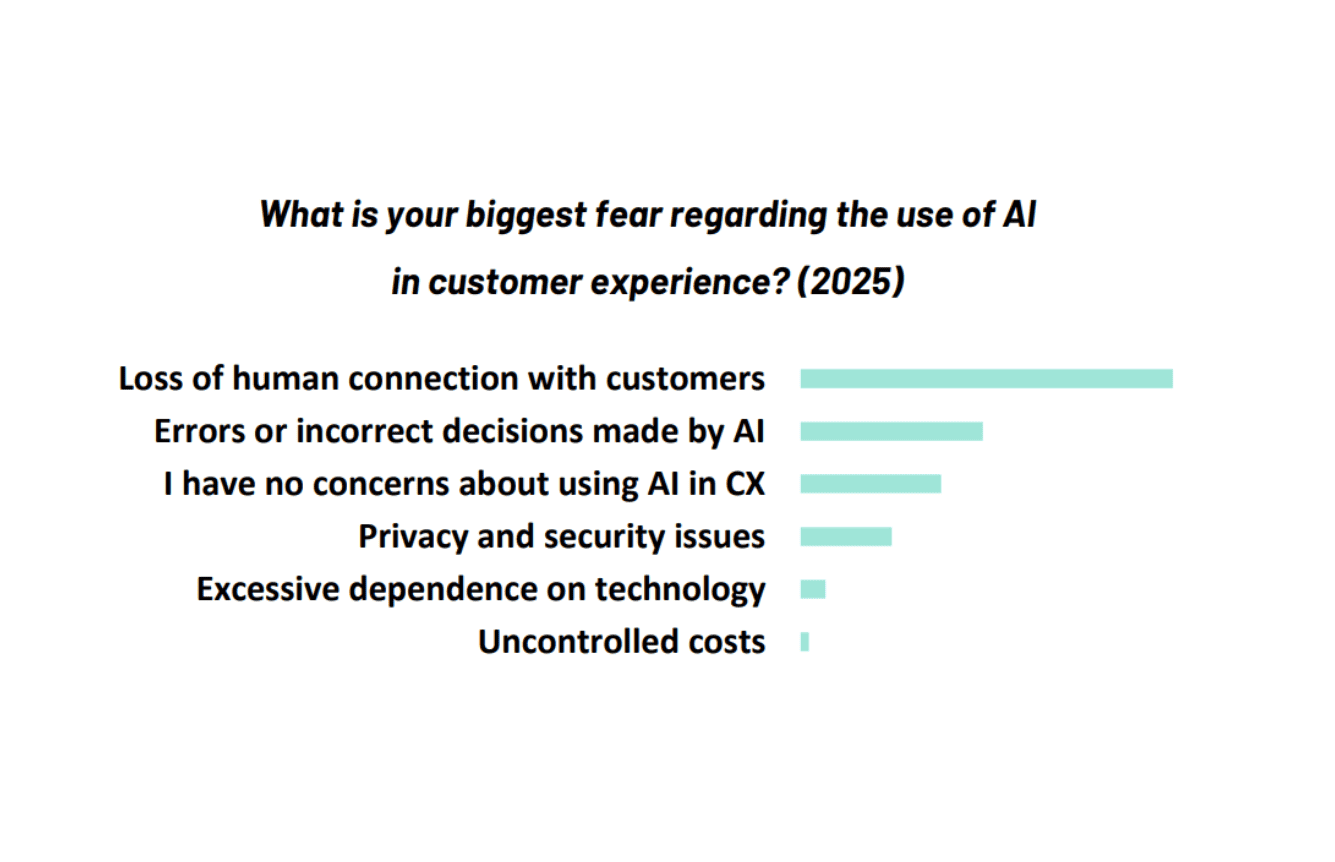
This creates what the study describes as an AI paradox: organisations want the efficiency and scalability of AI, but they don’t want technology to replace the human qualities that make customer interactions meaningful.
The answer is unlikely to be choosing between humans and AI. Instead, the next stage of CX maturity will depend on understanding where automation genuinely improves the experience and where human empathy, judgement, and personal interaction remain essential.
What Does This Mean for CX Maturity in Romania?
Taken together, the findings show a market that is clearly moving forward.
Romanian organisations are developing formal CX strategies, building more specialised teams, strengthening customer-centric cultures, and introducing more sophisticated processes and technologies. But the next level of maturity will require more than adding another CX initiative or implementing another technology.
The challenge is connection:
- connecting CX strategy with investment;
- connecting customer-centric values with everyday behaviour;
- connecting CX teams with real decision-making power;
- connecting customer insight with operational processes;
- connecting technology with a complete view of the customer;
- and, increasingly, connecting AI efficiency with human empathy.
As cited above, the true CX maturity begins when the voice of the customer becomes part of business decision-making. The organisations that can make that connection consistently will be better positioned not just to meet customer expectations, but to differentiate themselves through the experiences they deliver.
Want the Full CX Maturity Study Romania?
This article highlights just some of the findings from the comprehensive study by Staffino and Customer Experience Romania. The full research goes deeper into the data, trends, and maturity of Romanian organisations.
Want to see where your organisation stands?
Get the full CX Maturity Study Romania with complete numbers and brand names, and use the findings to benchmark your organisation, identify gaps, and build a more informed CX strategy.
You can get the full study in two ways:
- Purchase the study directly from the Customer Experience Romania e-shop.
- Contact the Staffino sales team at [email protected] to request the full report and learn more about how the findings can support your CX strategy.
The next article in the series will explore another critical part of CX maturity: how Romanian organisations listen to customers, manage customer journeys, and turn feedback into action. Be the first to know when a new Staffino article goes live—subscribe to our newsletter!